
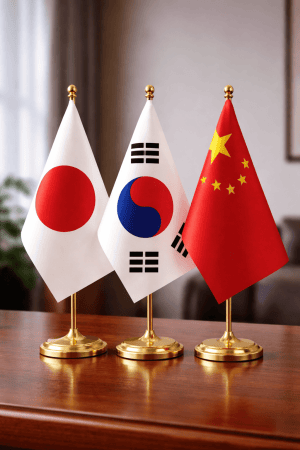
I travel a lot, and I feel like I’ve accumulated enough passport stamps and stressful experiences to be reasonably competent at it. That said, in a few days, Ken and I are heading to Asia on an ocean cruise with Regent Seven Seas. Why a cruise? Honestly, I figured it would be a good way to get a broad introduction to this corner of the world. If we love it, we can always come back for more.
After a couple of days in Tokyo, our cruise will head around the southern part of Japan, stop for two days in Seoul and another two days in Shanghai, and then back to Tokyo. This will be my first time in Asia, but Ken was stationed in Asia when he was on active duty with the Marine Corps. But that was a long time ago.

And while we won’t be on a self-supported backpacking trip through Mongolia, this will be . . . different. The rulebook I use for European travel won’t apply in Asia. So, I’ve spent the last several weeks soliciting advice, and reading approximately every travel article ever written about these three countries.
Here is the intel I’ve gathered so far. We’ll see on the back end of our trip how all of this information and advice holds up.
Seasoned Japan, South Korea & China travelers – if you have any advice to add, please let me know in the comments.
🇯🇵 🇰🇷 🇨🇳 Universal Advice
Carry Your Passport with You

It’s a legal requirement in all three countries, and you could be detained or fined if you are stopped and don’t have your passport with you. I’ve seen Locked Up Abroad. I don’t want to be detained in any of these countries, but especially not in China. So my passport will be glued to my body.
Get an eSIM Before You Leave
Preferably one that covers all three countries. An eSIM means you always have maps, translation, and a way to reach someone. Load it before your US flight departs.
Download Google Translate with all Three Languages Offline
The camera translation feature – point your phone at any text and translate in real time – works for menus, signs, labels, anything. It is genuinely one of the best tools available to a traveler right now, and I intend to use the hell out of it.
Alert your Bank and Credit Cards
I’ve forgotten to do this on trips before. It’s a hassle (and major time suck) when you’re trying to buy something and your card won’t work.
Don’t Tip
Not in Japan, not in Korea, not in China. It can actually be considered rude. It’s really difficult for Americans to un-learn the tipping thing, but I’ll do my best.
Expect to be Wrong About Things
No amount of research fully prepares you for the actual experience of arriving somewhere completely new. There will be situations that no amount of research can anticipate. That’s just what travel is.

FOUR IS DEATH
The number 4 is unlucky in all three countries. The words for 4 in all three languages sounds identical, or very similar, to the words for death, so the number 4 is often shunned.
A very good friend of ours used to work at a bank in Southern California. She had a Chinese customer who wanted to open a new account. When she handed the customer her new account number (which had a number 4 in it), the customer handed it back and shouted, “NO. FOUR IS DEATH!!” and demanded a new account number, sans 4. She told us this story 30 years ago, and we have never forgotten it. In fact, “FOUR IS DEATH! ” is part of our family lexicon.
🇯🇵 Japan: Everyone Loves Japan
Every single person I have mentioned Japan to has responded the same way – some variation of, “oh my god, you’re going to LOVE it.” That’s a pretty high bar.
The Cash Situation
Because Japan has a reputation as an ultra-modern, high-tech country, I wasn’t even considering needing cash. But I’ve been told (several times) that Japan is a cash country. Cash?? Who carries cash anymore? I guess we’ll be hitting up an ATM pretty quickly once we arrive – the consensus advice is to use the ATMs found in 7-Elevens, Family Mart, and Lawson convenience stores.
Ken would like me to point out that he found the equivalent of $9 in yen in our basement (I have no idea where this stash came from). So he’s pretty much bankrolling this trip.
Related to cash: When you’re paying for something, do not hand cashiers cash – place it on the tray on the counter. You’ll receive your change on the tray too. No hand touching. I’m OK with it.
Getting Around
I’ve gotten lots of advice about how to use Japan’s train system, which is supposed to be legendary – for efficiency, cleanliness, and the art of standing in line. I don’t anticipate having much of an opportunity to use the train system, though. Most of our “getting around” in Japan will be on board the ship, and excursions from the ship. I predict a herd bus or two in our future, but mostly I’ve planned outings on our own.
Etiquette Rules

I’ve read a lot about Japan’s unique set of etiquette rules, and they all seem to tie back to one central rule: do not disturb the harmony. I’ve been trying to collect some of the biggies:
- Always remove your shoes when entering homes, temples, and some restaurants.
- I bought a pair of slip-on/slip-off sneakers for this rule.
- Keep your phone on silent (manners mode). Honestly, this is something that should be universal.
- No talking on the phone while on trains or buses. I’m on board with this rule.
- Avoid eating while walking (common in some areas, but still considered impolite).
- Don’t blow your nose in public – step aside if needed. Noted.
- Carry your trash with you – public trash cans are rare.
- Use both hands when giving or receiving something.
Food & Drink
I know I’ll be faced with a lot of sushi in Japan. Unpopular opinion: sushi is gross. It’s a beautiful food, but it’s gross. Before the sushi mafia comes for me – I have tried sushi. Multiple times, in multiple configurations, prepared by people who know what they were doing. And every single time, my brain throws up a giant NOPE sign. There is no amount of soy sauce or social pressure that can get me past this. I cannot do raw fish. Now, you wanna make me some vegetable sushi? I’m all over that.
I am looking forward to just about every other Japanese food: ramen, udon, tempura, wagyu beef, yakitori skewers, okonomiyaki (savory pancakes), gyoza. I’ll be juuuuust fine.
I will, however, be skipping the takoyaki, which has been described to me as gooey octopus balls. Gooey should never modify octopus. Hard pass.
Must try drinks: Sake, matcha tea, and Japanese whisky I’ll be skipping this one. Japanese whisky uses the Scotch blueprint, and I cannot stand Scotch. I’m a bourbon girl, all the way.
Convenience Stores (Konbini)
7-Eleven, Lawson, and FamilyMart offer great food, clean restrooms, and reliable ATMs. They are abundant, and open 24-7. I’ve been told I need to try some kind of crustless egg sandwich situation. As long as it doesn’t involve raw fish, I’m game.

I consider grocery stores cultural experiences when we travel, so I feel certain I’m going to enjoy the Konbini.
Bowing & Sitting
Be prepared to bow. A lot.
Get used to kneeling on the floor. My knees find kneeling to be a special kind of uncomfortable, so I’m not sure how this is going to go. I can still sit criss-cross-applesauce (Americans of a certain age will remember we used to call this position Indian style). Not for long, but I can do it.
Toilets
Japanese toilets are next-level. I’ve been told that pressing random buttons on the panel next to you on the toilet can be an exciting activity. Apparently, there is a STOP (■) button if things go too far. Good to know.

You might find toilet slippers outside bathrooms. Take off your nasty shoes and use the slippers.
Silence is golden in public restrooms. Use the “flush sound” button (the one that looks like musical notes) to mask your business. OK, this is genius.
🇰🇷 South Korea: Easy-Peasy
Of the three countries, South Korea has consistently been described as the most approachable for first-timers – modern, efficient, English-friendly in tourist areas, and one of the best food scenes on earth.
Language
In Seoul’s tourist areas, English is not a problem. Signs are bilingual, menus often have photos or English translations. Huzzah.
Money
South Korea uses the Korean won. However, I’ve been told that Apple Pay works almost everywhere in Seoul now – a recent development that contradicts a lot of older travel advice still floating around the internet. I’ll still plan on carrying some cash for street food and markets.
Getting Around
Again, I hired a guide for our days in Seoul, so I don’t anticipate getting around to be a problem. It is a little disconcerting, though, to think how much blind trust is involved in these tours.
Etiquette
- Always give and receive items (money, gifts, business cards) with both hands.
- Never pour your own drink; wait for someone else to fill your glass, and return the favor. Pour with two hands.
- Blowing your nose in public, especially while dining, is considered unhygienic and impolite.
Food & Drinks

I’m super excited to try Korean BBQ and Korean fried chicken (I love them both here in the US – how will they be different in Korea?) I have been warned that Seoul is a city where you will eat constantly and never quite feel like you’ve had enough.
My favorite piece of food advice so far: There will almost always be pictoral menus outside of restaurants and street food vendors. If the sign and pictures look sketchy, it’s 100% sketchy.
Must try drinks: Makgeolli (rice wine) wine and Soju (think: Korean vodka).
🇨🇳 Shanghai: My Phone is About to be an iPotato
For both diplomatic and logistical reasons, Shanghai is the stop I’m most intimidated by. But it also might be the stop I’m most curious about.
China operates on entirely different systems from anything I’ve encountered, and the universal warning from every single person who has been there is some version of: do the tech setup before you leave home, or you will spend a significant portion of your trip confused and offline.
Got it. Doing the tech setup.
The Great Firewall
China blocks Google, Gmail, Google Maps, Instagram, Facebook, WhatsApp, YouTube, and most Western news sites. The moment you cross into Chinese territory, your phone stops working the way you expect it to.

The solution is either an eSIM or VPN (or both) that routes your traffic through another country. But you must set this up before you get on the plane. You cannot download VPN apps in China.
Cashless Payments
Shanghai rarely uses cash. But it also doesn’t run on credit cards the way we do. Shanghai runs on two mobile payment apps – Alipay and WeChat Pay – where you scan a QR code to pay for everything. Both apps allow foreigners to link an international Visa or Mastercard. But set this up before you get to Shanghai.
Getting Around
Again, I hired a guide. So I don’t anticipate getting around to be a problem.
For navigation: Download Amap (Gaode Maps), which now has an English version and is what the locals use.
Etiquette
- Don’t point at people. It’s considered hostile and extremely rude. The last thing I want to be in China is hostile and rude.
- Do be a good sport. I’ve been told to expect people to be curious about me because I’m tall, blonde, and very fair. People might ask to take a picture with me. I can do that. I hope they’re OK with reciprocation.
Food & Drink

Shanghai is famous for its soup dumplings and pork buns. Two of my favorite things. I’m excited to try them in Shanghai. I booked us a food tour – I don’t want to spend time looking for places to eat. I want to eat.
Must try drinks: Baijiu (a clear liquor made from sorghum, and the world’s most consumed alcoholic beverage by volume). And tea. Lots and lots of tea.
I’ve been told NOT to drink tap water in Shanghai. Only drink bottled water. You don’t have to tell me twice. I’m not a fan of intestinal parasites, so bottled water it is.
On a related note: I’ve been told to carry tissues and hand sanitizer in Shanghai. Public bathrooms exist (squat toilets are standard), but don’t always have toilet paper or soap.
Visas
The rules about whether cruise passengers need or do not need a visa are about as clear as mud. For US cruise passengers, a visa is usually required to enter China – but there are limited exceptions related to whether you are doing a cruise sponsored excursion or on your own. We are on our own, so I applied for a visa to cover our bases.
I have not received said Visa yet. I’m starting to get a little nervous.
Concluding Thoughts
I have downloaded my apps, set up my payment systems, alerted my bank, and accepted that I am about to be a travel novice again.
I can’t wait.
If you can think of anything to add to this, pile on in the comments.
Kampai / Geonbae / Ganbei! 🥂


Leave a Reply