

Argentina is, by law, a wine country. I’m not making this up. In 2013, Argentina’s Congress declared wine the official bebida nacional — national drink — which tells you just about everything you need to know about Argentina’s relationship with the stuff.
But if you’re wondering what to drink in Argentina, wine is only part of the story. There’s yerba mate passed between friends, Fernet Branca mixed with Coca-Cola, bitter aperitivos before dinner, espresso at cafés where nobody seems remotely interested in hurrying — and, yes, an awful lot of Malbec.
Argentina tells you a lot about itself through what it pours, passes around, and drinks very, very slowly.
Argentine Drinks at a Glance
A Field Guide to What Argentina Drinks
| Drink | What It Is | The Experience |
|---|---|---|
| Malbec | Rich, velvety red wine | The undisputed king of the asado |
| Torrontés | Dry, intensely floral white wine | Smells like perfume. Tastes nothing like it. |
| Yerba Mate | Bitter, caffeinated herbal infusion | Stewed lawn with a side of social bonding |
| Fernet con Coca | Fernet-Branca, Coke, and ice | Argentina’s unofficial national cocktail |
| Quilmes | Crisp, easy-drinking lager | Cold beer, hot afternoon, no complications |
| Campari & Cynar | Bitter aperitivos | Proof that Argentines appreciate a bitter drink |
| Gancia | Citrusy herbal aperitif | Something to sip while waiting for dinner |
| Amargo Obrero | Bitter Argentine aperitif | Revolution, now with ice |
| Hesperidina | Bitter-orange aperitif | Argentina’s homegrown citrus classic |
| Cortado | Espresso with a little milk | Best enjoyed without a schedule |
Malbec and Torrontes: The Giants of Argentine Wine
Malbec
You can’t talk about Argentina without talking about wine, and you can’t talk about Argentine wine without talking about Malbec. Originally from southwest France, Malbec plays a supporting role in Bordeaux blends, but struggles with the cool, damp climate there. Malbec arrived in Mendoza in the mid-19th century, and in the high, dry, sun-drenched vineyards of the Andes, it found its footing. Apparently, all it needed was a change of address.


Argentine Malbec is richer, darker, and more velvety than its French cousin. It’s built for red meat, and Argentina has a lot of red meat. The classic pairing is asado (barbecue). Argentine barbecue is its own religion, and Malbec is the only appropriate sacrament.
There are plenty of perfectly serviceable, inexpensive Malbecs exported from Argentina. But the single-vineyard and high-altitude wines from producers like Achaval Ferrer, Catena Zapata, and Zuccardi can be an entirely different (and genuinely exceptional) animal.
Torrontés
White wine drinkers aren’t left out. Argentina has its own signature white grape, Torrontés, grown mostly in the far-northern province of Salta, in the high-altitude vineyards of the Cafayate Valley.


Torrontés is wildly aromatic — peach, citrus, white flowers. It smells like someone knocked over a bottle of perfume.
And I hate it.
Back in the throes of somm school, I used to hope I’d get Torrontés on my blind tasting exams, because I could identify it by smell alone and write the whole tasting note without ever taking a sip. It’s that distinctive.
Here’s the twist: despite smelling like the inside of a Sephora, Torrontés is bone dry. The aromatics are enormous, the palate is zippy, and the acidity keeps the whole thing from collapsing into sweetness. If that sounds like your kind of wine, you’ll love it.
I’ll stick with Riesling.
But if floral wines are your jam, Torrontés is great with spicy dishes, seafood, and anything with citrus. Whatever you do, don’t pair it with heavy red meat. That’s what the Malbec is for.
Yerba Mate in Argentina: The Ritual of Sharing
You can’t spend much time in Argentina without noticing people carrying little gourds with metal straws sticking out of them. What’s inside is mate (pronounced mah-tay), and it’s practically a national obsession.
Actually, make that officially a national obsession. In 2013, the Argentine government declared mate the infusión nacional, the same year it designated wine the national drink. Argentina has all of its beverage bases covered.
So, What Exactly Is Mate?
Mate is an herbal infusion made from the dried leaves of Ilex paraguariensis, a plant native to South America. The leaves go into a hollowed-out gourd (also called a mate), hot water gets poured over them, and you drink the whole situation through a metal straw called a bombilla. The straw has a built-in filter to keep the leaves out of your mouth, which is helpful because nobody wants shrubbery stuck in their teeth.
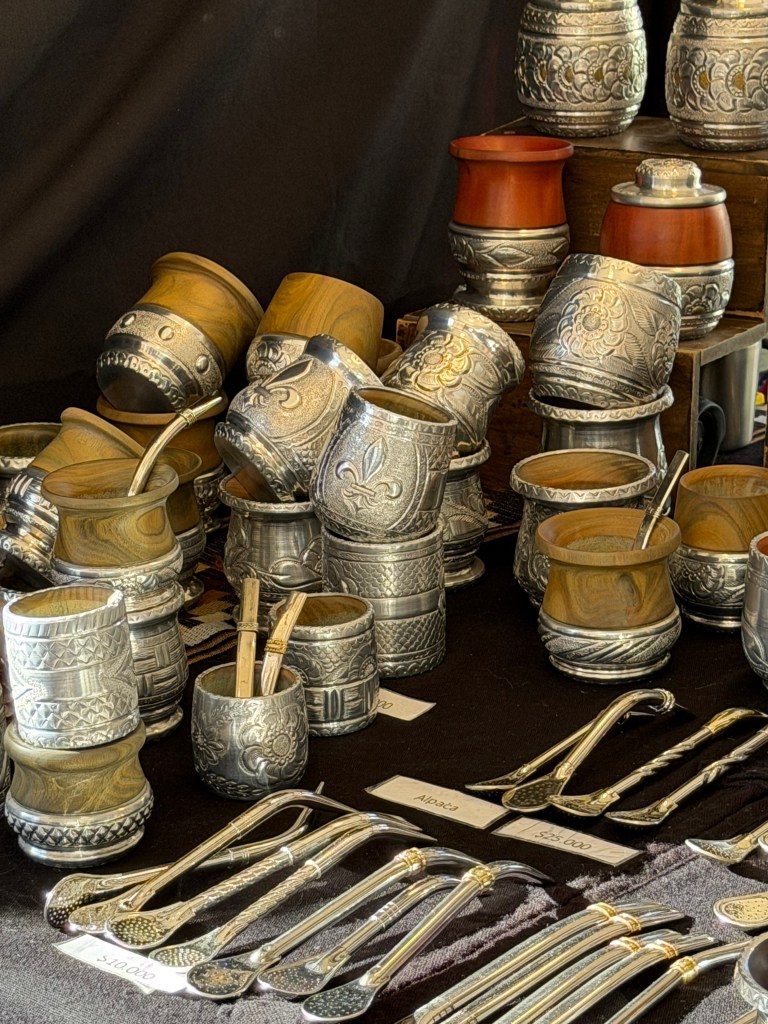

And the taste? Grassy, earthy, bitter. It’s an acquired taste, and I have not acquired it.
There’s caffeine involved, too, which helps explain why Argentines seem to carry the stuff everywhere.
Argentina’s Original Emotional-Support Beverage
Watching Argentines haul around their gourds and thermoses reminded me of the Stanley tumbler phenomenon in the US. Except Argentines were carrying their emotional-support beverages long before Americans decided they couldn’t make a trip to Target without 40 ounces of hydration in tow.
Stanley saw the opportunity — they now make mate cups.

But unlike the Stanley craze, mate isn’t just about the container or what’s inside it. It’s a social ritual, and there are rules.

One person, called the cebador, is in charge. They prepare the mate, drink the first (and usually most bitter) round, then refill the gourd and pass it along. Everyone drinks from the same straw, finishes their portion, and hands the gourd back to the cebador for a refill.
This continues around the circle until someone says gracias, which doesn’t mean thank you, that was lovely. It means I’m done. Say it too early, and you’ve just taken yourself out of the rotation.
Sharing mate is a gesture of friendship and hospitality. If someone offers you their gourd, they’re inviting you into their circle.
Sorry, Mate. I’m Just Not That Into You
We had our own little mate circle at the estancia in Entre Ríos. Ewan, one of the estancia’s managers, brought out his gourd and passed it around so we could all have a taste.


My reaction? Gracias.
None of us are rushing out to buy a gourd and metal straw anytime soon.
To be fair, I disliked mate considerably less than I did on our first trip to Argentina several years ago. So I guess that’s progress. But I still can’t get past the fact that it tastes like someone boiled the contents of a lawn mower bag.
I don’t see myself becoming a mate drinker anytime soon. But I do understand why Argentines love it. It’s an excuse to sit together, talk, and pass something around without anyone checking the time.
I can appreciate that. Even if I’d rather have a glass of wine.
Fernet con Coca: Argentina’s Unofficial National Cocktail
Fernet-Branca is an intensely bitter, aromatic Italian liqueur, created in Milan in 1845 and carried to Argentina by Italian immigrants in the late 1800s. It’s made from a secret (it’s always a secret) blend of 27 herbs, spices, and roots. When Argentines say Fernet, they mean Fernet-Branca.

Originally marketed as a medicinal tonic, Fernet was touted as a treatment for everything from indigestion to cholera. It even has a history tied to America’s Prohibition era, when doctors could legally prescribe alcohol for medicinal purposes. Because you never knew when your gout was going to act up.
The Bartender’s Handshake
In the US, Fernet has become an unspoken password among bartenders and hospitality workers. Order a shot of it at the bar, and the bartender will likely clock you as beverage industry — or industry-adjacent. It’s also the traditional shot passed around among coworkers at the end of a long shift.
I don’t love it. Fernet is aggressively herbal, bitter, and minty — somewhere between cough syrup and an herb garden. But after eight-plus hours of dealing with the public, I understand the appeal. Sometimes you don’t need a delicious drink. You need a drink that understands what you’ve been through.
The Fernandito
Argentines, however, figured out how to make Fernet entirely their own: add Coca-Cola and a lot of ice.
The result is Fernet con Coca, also known as the Fernandito. It took off in the province of Córdoba and spread from there to become Argentina’s unofficial national cocktail. It’s even available pre-mixed in handy 1 liter bottles.
To make your own, the classic ratio is roughly 30% Fernet to 70% Coke, in a glass packed with ice. Pour the Coke slowly. Fernet and carbonation have an enthusiastic relationship, and if you rush things, you’ll get considerably more foam than cocktail.


Did I enjoy it? No. No, I did not.
There’s a reason Coca-Cola has never released Coke Mint. Fernet con Coca tastes exactly like I imagine that product-development meeting ended.
But whether I like it is beside the point. Argentines love it. Fernet con Coca is a social drink — the thing that shows up at parties, after long dinners, and any occasion where nobody seems particularly interested in going home.
Fun fact: Argentina drinks more than 75% of all the Fernet Branca produced in the world. Three out of every four bottles. The Italians may have invented it, but the Argentines are the ones keeping it in business.
Argentine Beer: Quilmes
Argentina is fundamentally a wine country. But if you are fundamentally a beer person, there is Quilmes.

It’s cold, crisp, inoffensive, and absolutely everywhere. Founded in 1888 by a German immigrant, it’s the beer of asados, hot afternoons, fútbol matches, and any situation where you want something cold and don’t particularly want to think about it.
And that’s really all the attention we’re going to give beer in a country that legally declared wine its national drink.
Argentine Aperitifs: Campari, Cynar, Gancia, and Amargo Obrero
Thanks to Argentina’s deep Italian and Spanish roots, the aperitivo tradition is alive and well in Buenos Aires. Which makes sense, because dinner in Buenos Aires doesn’t get started until an hour when most Americans are getting ready for bed.
You have to do something between lunch and your 10 pm dinner reservation.
Fortunately, Argentines have embraced the art of the pre-dinner drink. At old-school bodegones (traditional neighborhood taverns) and trendy cocktail bars alike, bittersweet aperitifs are a perfectly respectable way to pass the time. And unlike the Italians, who tend to have their aperitivo hour reasonably under control, Argentines seem happy to stretch the whole affair well into the evening.
Here are a few worth knowing about (along with some really cool advertising posters I found while researching).
Campari
My introduction to Campari came when I was about 23, newly married, and visiting Ken’s Opa in Munich. Opa loved Italy and everything Italian, including Campari. One evening, he convinced me to try some.


Campari is a beautiful drink. Bright, brilliant red. It looks like it should taste like cherries, sunshine, and all the good things in life.
It does not.
Straight Campari is bitter, herbal, and bordering on combative. I took one sip and wondered if I was somehow being punished for not finishing my Leberkäse at dinner.
But Opa was onto something. Over the years, I’ve developed a real appreciation for Campari, provided it’s mixed with something that takes the bitter edge off.
Argentina agrees. It’s one of Campari’s biggest markets, and you’ll find it mixed with orange juice (a Garibaldi), topped with soda, or making an appearance in a Negroni.
It took me ancouple of decades, but I finally understand what Opa saw in it. I still wouldn’t drink it straight, though.
Cynar
Yes, it’s made with artichokes. No, it doesn’t taste like artichoke dip. This Italian amaro has become a Buenos Aires favorite, particularly in the Cynar Julep — a refreshing combination of Cynar, grapefruit juice, lime, fresh mint, and soda.


That sounds like it would be a toothpaste and orange juice situation, but I promise it’s not. We ordered one at a café one afternoon, and I was genuinely surprised by how much I liked it. Bitter, citrusy, herbal, and refreshing without being sweet. It was easily one of my favorite drinks of the trip.
Who knew artichokes had this kind of beverage potential?
Gancia
Another Italian import that’s become thoroughly Argentine. Gancia Americano is a sweet, citrusy, herbal aperitif, often served as a Gancia Batido, shaken with lemon juice, sugar, and ice. You’ll also find it mixed with Sprite or tonic and a slice of lemon. Easy-drinking and refreshing.
It’s the sort of drink that goes down suspiciously easy, particularly when you’re killing several hours before a dinner reservation that isn’t until 10 pm.


Amargo Obrero
Now here’s a drink with a little political baggage. Created in Rosario in the late 1880s by Italian immigrants, Amargo Obrero — literally “workers’ bitter” — was a working-class answer to the sweeter drinks favored by the wealthy. Its distinctive red-and-black label became associated with the anarchist movement of the era.

It’s bitter, herbal, and traditionally mixed with cola or tonic and a slice of lemon.
Revolution, now with ice.
Hesperidina: Argentina’s Own Aperitivo
One of Argentina’s oldest commercially produced alcoholic beverages is a bitter orange aperitif called Hesperidina, created in 1864 by Melville Sewell Bagley, an American immigrant from Maine. It was also the first product to receive a registered trademark in Argentina.

Hesperidina is made from sweet and bitter orange peels, and lands somewhere between Campari and Grand Marnier: citrus-forward, herbaceous, lovely on its own, and excellent with tonic. It’s been largely forgotten outside Argentina, which is a shame, because it’s really good.
It’s also Argentine in a way that Fernet, technically, is not.
Coffee Culture in Argentina
Argentina may be in South America, but its coffee culture is decidedly Italian. Thanks to the millions of Italian immigrants who arrived in the late 19th and early 20th centuries (who brought more with them than Fernet-Branca), Buenos Aires developed a serious espresso habit. And unlike the grab-and-go coffee culture in the United States, Argentines generally prefer to sit down, order something to eat, and take their time.
A lot of time.
Buenos Aires is full of cafés, from grand old establishments with marble tables and waiters in bow ties to modern specialty coffee shops.
What to Order
Café: A straightforward shot of espresso. Small, strong, and generally served with a little glass of water.

Cortado: Espresso cut with a splash of warm milk. One of the most popular coffee orders in Argentina, and a good choice if you want something stronger than a latte but less aggressive than straight espresso.
Café con leche: Roughly equal parts coffee and hot milk, traditionally served in a larger cup. A breakfast staple, often accompanied by medialunas, Argentina’s slightly sweeter, softer answer to the croissant.

Lágrima: Literally meaning “tear,” this is mostly steamed milk with just a few drops of coffee. Perfect for people who enjoy the general idea of coffee without wanting much actual coffee.
Submarino: Now here’s where things get interesting. A submarino isn’t coffee at all. It’s a glass of steaming hot milk served with a solid bar of chocolate, shaped like a submarine. You drop the chocolate into the milk, watch it sink, and stir until it melts into hot chocolate. It’s essentially a drink and a small science experiment. What’s not to like?
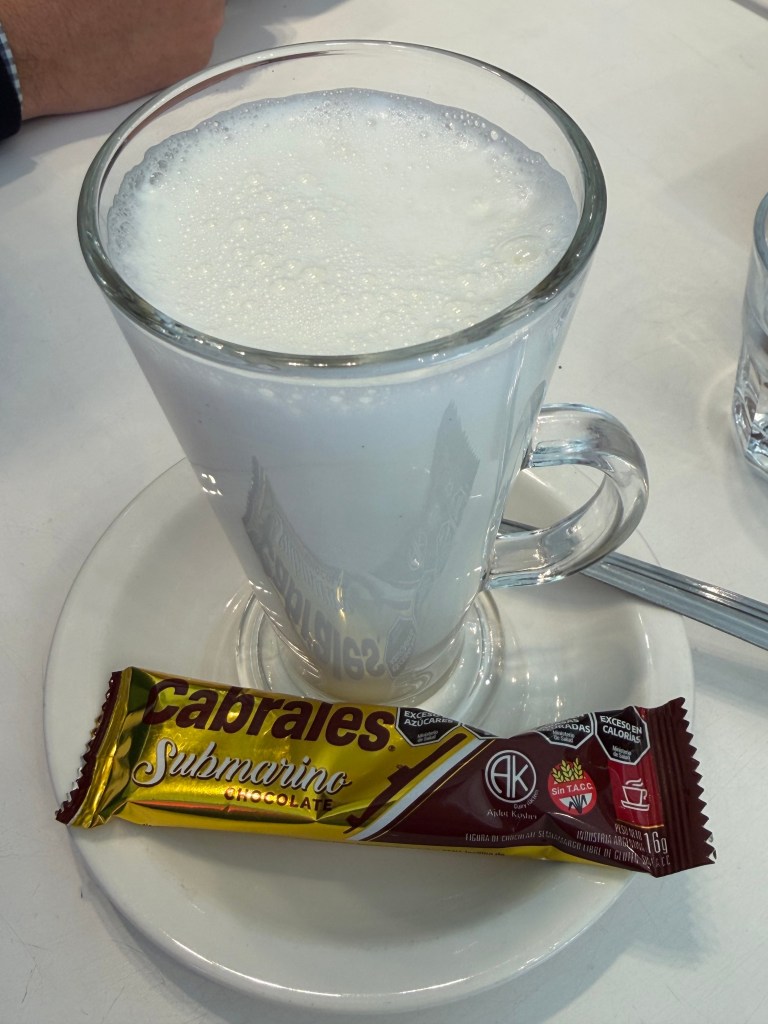


Coffee in Buenos Aires isn’t just about the caffeine. It’s about the ritual. Sit down, order a cortado and a couple of medialunas, and watch the city go by. Nobody seems particularly concerned about how quickly you finish.
The Final Sip
In Argentina, nobody seems to drink quickly, and almost nobody drinks alone. The mate goes around in a circle. The Fernandito gets passed down the table. A bottle of Malbec lasts through an asado. And the waiter at the café will let you nurse a cortado until next Tuesday.
For a country that has gone so far as to legislate its national beverages, Argentina’s drinking culture isn’t really about what’s in the glass.
Nobody needs another drink. They just aren’t ready to leave.
Salud!
Leave a Reply