

We covered a LOT of ground today. (Fair warning – this is going to be a longer post than usual.) Super grateful to our guide, Necdet, for shepherding us through his beautiful (but chaotic) city.
Spent most of the day crowd surfing through the must-sees of Istanbul: the Hagia Sophia, the Basilica Cistern, the Blue Mosque, and finally, the Grand and Spice Bazaars.
But first, our driver needs coffee. The method for getting coffee to-go in Istanbul is to pull over near a coffee shop and yell out the window. Other drivers will honk and/or yell at you, but sure enough, someone will bring you a coffee, and off you go.
Hagia Sophia
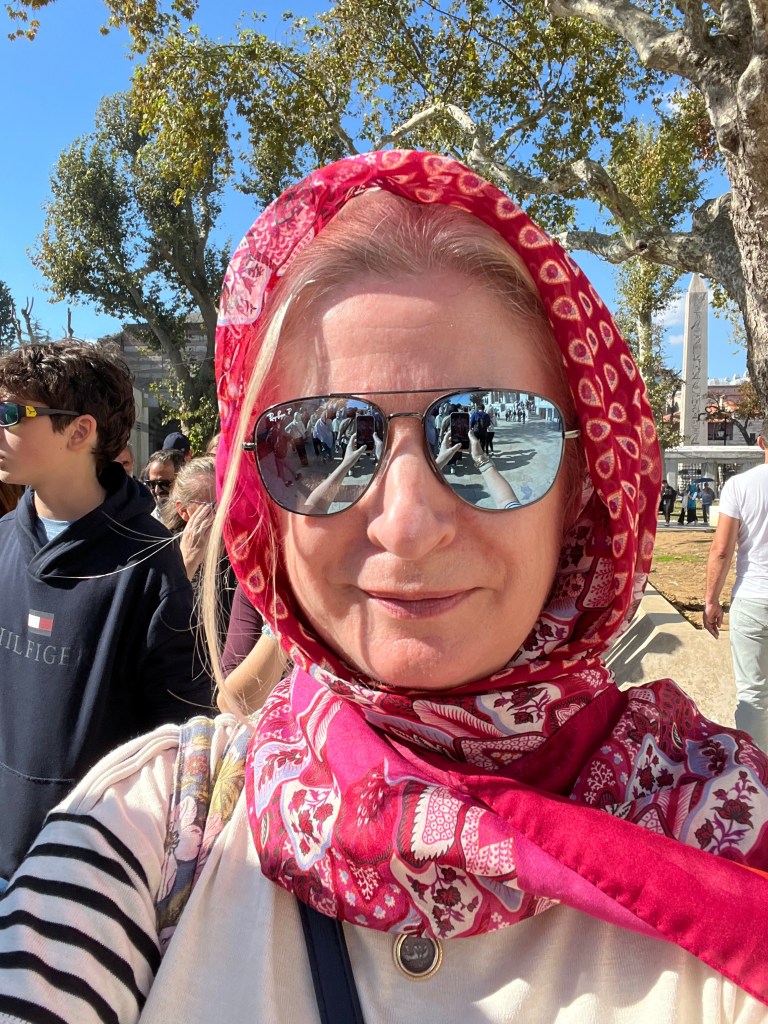
The line to get into the Hagia Sophia was long – infinitely long. But Necdet (and I’m sure other guides) have a plan. Cut the line. How? Well, you search the line to find one of your colleagues who has a better position, have a joyous mini-reunion, and then you just merge into the line with them. People around you shoot you all kinds of side-eye, but you pretend not to notice.
Sidebar: Remembered my head scarf for the mosques, so didn’t have to buy another Chaneel masterpiece.
Stood in line long enough to get a complete history of the Hagia Sophia, or “Holy Wisdom” church/mosque. It has been repurposed so many times, I had to make myself a handy chart to sort it all out:
| Year(s) | Event | Description |
|---|---|---|
| c. 360 | First Church / Byzantine Empire | Emperor Constantius II built the original structure with a wooden roof. It burned to the ground during some sort of riot. |
| 532 | Second Church / Byzantine Empire | They rebuild, but use wood again. More riots. It burns to the ground again. No one is that surprised. |
| 532–537 | Construction / Byzantine Empire | Emperor Justinian I commissions the current structure. They do not use wood for construction. |
| 537 | Consecration / Byzantine Empire | Opened as the principal Eastern Orthodox cathedral. |
| 1204–1261 | Latin Empire | Converted to a Roman Catholic cathedral during the Fourth Crusade. |
| 1453 | Ottoman Empire | Sultan Mehmed II captures Constantinople, and converts the HS into a mosque, but does not destroy the structure. He just adds to it. And plasters over all of the Christian mosaics. |
| 1935 | Museum Opening / Secular Rule | Kemal Atatürk secularizes the building, and opens it as a museum. Many of the original Christian mosaics are discovered and uncovered. |
| 1985 | World Heritage / Secular Rule | Declared a UNESCO World Heritage Site. |
| 2020 | Reconversion / More Religious Rule | President Erdoğan annuls the HS’s museum status, and it reverts to a mosque. Christian motifs are covered during prayer times, but not permanently. |
Hands down, the inside of the Hagia Sophia is one of the most beautiful spaces I have ever seen. And even if you set the astonishing architecture aside, the Hagia Sophia is incredible as a piece of living history – it has changed and evolved for over a thousand years, reflecting countless political and cultural shifts. Christian and Islamic motifs coexist in there a visual dialogue that tells this story far better than any history book or handy chart could.

Basilica Cistern
Next on Necdet’s tour agenda: the Basilica Cistern. Another mob line to get in. Necdet can’t seem to find a colleague, so he just simply chose a point to merge and voila, now we’re in line. A Turkish lady is not happy about this, and is shouting very angry Turkish words at us. We let Necdet deal with her wrath.
The Basilica Cistern is a cathedral-like world that lies beneath the chaotic streets of Istanbul. It was built in the 6th century under Byzantine Emperor Justinian I, and supplied water to the Great Palace of Constantinople. The cistern holds 80,000 cubic meters (or 21 million gallons for the metrically challenged) of water. Most of the columns were salvaged and repurposed from ancient Greek and Roman temples and ruins. It’s truly impressive.
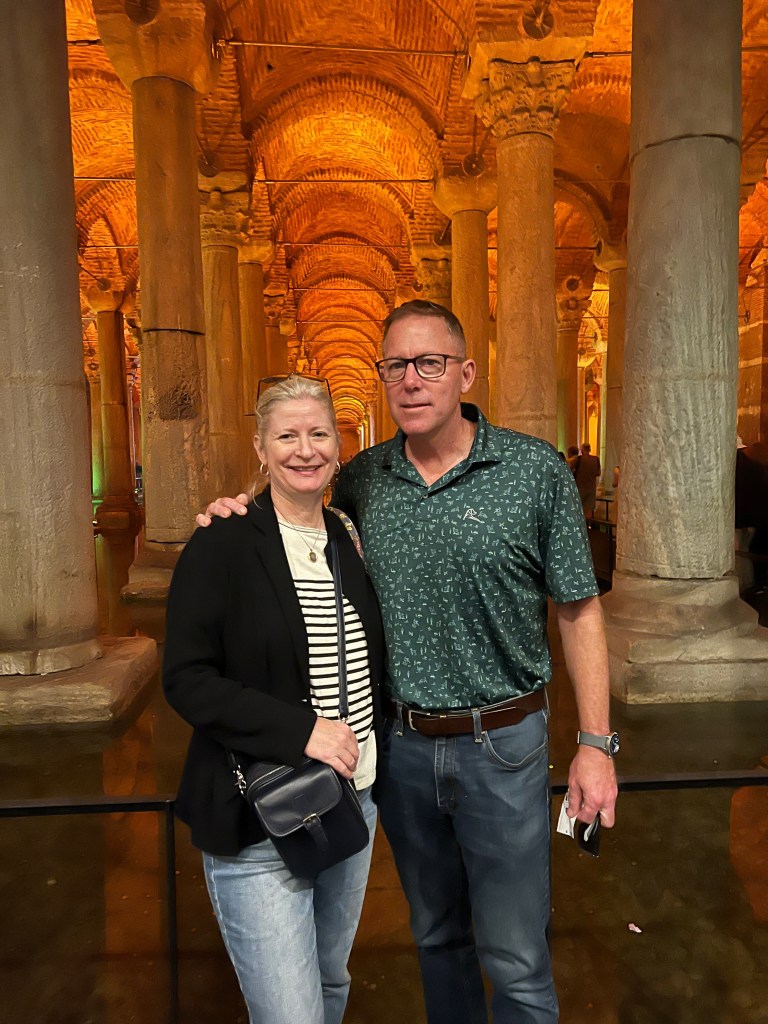

Next on the agenda is the Blue Mosque, but it doesn’t open to the public until 2pm, so we have some free time. What should we do? What should we do? Necdet knows exactly what we should do.
Shop for rugs.
The Rug Show
Went to visit the best rug store in Türkiye. Where every rug is the most special rug at the most special price – just for us. 
The rug show routine in Istanbul was exactly the same as the rug show routine in in Tunisia. With one exception: we got to see a woman who was actually making a rug on a loom from a pattern. It really is an incredible art.

Josef, the owner of this best rug store in Türkiye, couldn’t have been friendlier or more welcoming. Difficult to say whether that’s genuine or schtick. We were ushered upstairs into a private rug viewing room. We sit down knowing full well what’s about to happen, and yep, here comes the Turkish tea. I accept because I love tea. Ken hates tea, and declines, so Josef offers him apple tea, which turns out to be something only for tourists who hate tea, but it’s pretty tasty.


I must have looked like I needed more caffeine, because next Josef insisted I try real Turkish coffee – because he makes it the real way and not with a machine like they do in hotels. Still, I’m not a fan. It’s super strong, unfiltered, & has the consistency of sludge.


Out come the rugs. Rug after rug after rug after rug after rug. There are two assistants working their asses off lifting, opening, and displaying them on the floor. Have you ever tried to lift a 9×12 rug? They are HEAVY. If you say one is pretty, you get 10 more in that same vein.
Knowing we would probably be facing a rug show in Türkiye, we decided before we left for Türkiye that we would invest in one (smallish) rug. We’ve become friends with our own “rug guy” here in Virginia, and he’s been great at teaching us all about rugs. We settled on this spectacular tree of life rug – made in the town of Hereke, which is famous for its high-quality silk rugs.
Jewelry
But wait, there’s more. Josef’s rug store is also a jewelry store. And we must see it. I think Josef knows my weakness. I always try to buy some sort of jewelry from wherever we travel. From our good friend, Josef, I ended up buying a Byzantine reproduction necklace – agate, lapis, and jade. And later, Ken surprised me with this stunning Zoltanite ring I had admired. Zoltanite is a rare, natural, color-changing gemstone found only in a single mine in the Anatolian Mountains of Türkiye. Its color changes dramatically under different lighting conditions – green in outdoor/natural light, and brown in inside light. It’s wicked cool.


Sidebar: There has not been time for lunch today. Luckily, I am prepared with my emergency Snickers bar. But I do need to stop for a Fanta. It’s orange, not lemon, but I make do.
The Blue Mosque
Now that we’re done buying rugs and jewelry, and I’m no longer hangry, it’s time for the Blue Mosque, which is (not by accident) right across from the Hagia Sophia. Sultan Ahmed I commissioned the Blue Mosque in 1616 to rival the Hagia Sophia, and demonstrate the power of the Ottoman Empire.


It’s extremely impressive inside. But, from the get go, my focus was pulled because you have to take your shoes off before you enter. Have never been so glad to be wearing socks. Wow, that was a lot of bare feet. Had to turn off the part of my brain that thinks about foot germs.
Grand & Spice Bazaars
We were starting to run a little short on time, so Necdet led us, with a sense of urgency, through the Grand Bazaar. So many people. So many things. Didn’t buy anything. I was tempted with all of the gold shops, but I cannot shop when I’m rushed and/or “supervised”.


On to the Spice Bazaar, where Necdet knows where to get the best Turkish Delight. Have to admit, it was pretty good. Bought some pistachio nougat Turkish Delight. Also bought some Iranian saffron – because we’re not getting that at home.


Have learned the way to hail a cab in Istanbul is to wade out into four lanes of slowly moving traffic (because Istanbul traffic never moves very fast) and start scanning for an empty cab. Then, jump in while the cab slows down. That was jaunty. But I did not die, so now it’s an experience.

Turkish Hammam
Best thing we did today: I booked a traditional Turkish Hammam. A full body massage followed by a scrub & wash experience. You lay on this heated slab of marble while attendants scrub off layers of skin you didn’t know you had. But after spending most of the day rubbing elbows with strangers and marinating in cigarette smoke and exhaust, it felt pretty damn good.

The burning question: what do you wear? I bought myself a cheap, single-use bikini on Amazon. Single-use in that I threw it away after the hammam. I’m too old for bikinis in public situations.
Şerafe!
Postscript: I stopped counting cats at 53 today.  Note: these cat food vending machines are all over the city. You “feed” them with an empty plastic bottle, and cat food is dispensed. The cats of Istanbul are loved.

Travel date: October 10, 2025


Leave a Reply