
Vodka Anthropology: Drinking Habits and Traditions Under Soviet Rule in the Baltics
I’ve been studying wine & spirits for over a two decades. One of the things I’m most interested in when we travel is what I call cocktail anthropology – what can you learn about a country through their cultural drinking habits and traditions. We just returned from a trip to the Baltic States – Estonia, Latvia, and Lithuania. And while I found many great things to drink in the Baltics, but I kept wondering how the years of Soviet occupation affected cultural drinking habits and traditions in that region.
After we got home, I was still thinking about this, so I went down a rabbit hole of research.
For the Baltic states, the 20th and 21st centuries were a whiplash-inducing jolt through sovereignty, socialism, and ultimately, freedom. Alcohol has been a consistent companion in the Baltics – sometimes a panacea, sometimes a problem, but always a presence. Political upheaval and freedom – whether from Moscow or the free market – directly influenced Baltic drinking habits and traditions.
The Soviet Influence

To understand drinking culture in the Baltics during the Soviet occupation, it’s important to understand that the whole Soviet system was a paradox. All at once, the Soviet the state publicly condemned, profited from, and surreptitiously encouraged, excessive alcohol consumption. Alcohol was both everywhere, and hard to get.
In a nutshell: Drinking harms the Motherland, and it’s incompatible with glorious socialism, so don’t do it. But the Motherland makes piles of money from alcohol sales. So here’s a steady, but sometimes irregular, supply of low-quality vodka so no one gets any revolutionary ideas. Bottoms up!
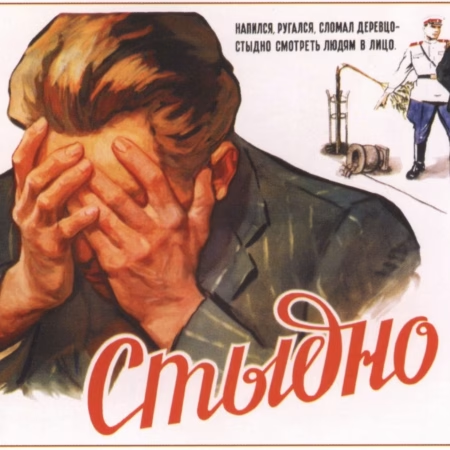
Sidebar: During my plunge down the research rabbit hole, I found a whole bunch of great Soviet anti-alcohol posters, which I will scatter throughout this post.
Historical Context
The Baltic States were annexed by the Soviet Union in 1940 (and briefly occupied by Nazi Germany from 1941–1944), then re-occupied by the Soviet Union until 1991. During this period, alcohol, especially vodka, was a significant source of income for the Soviet regime. But it was also a tool of manipulation and suppression. By fostering alcohol dependence at the individual and community levels, the Soviet authorities subtly undermined resistance and maintained control over the population.
Economic Dependence and Control
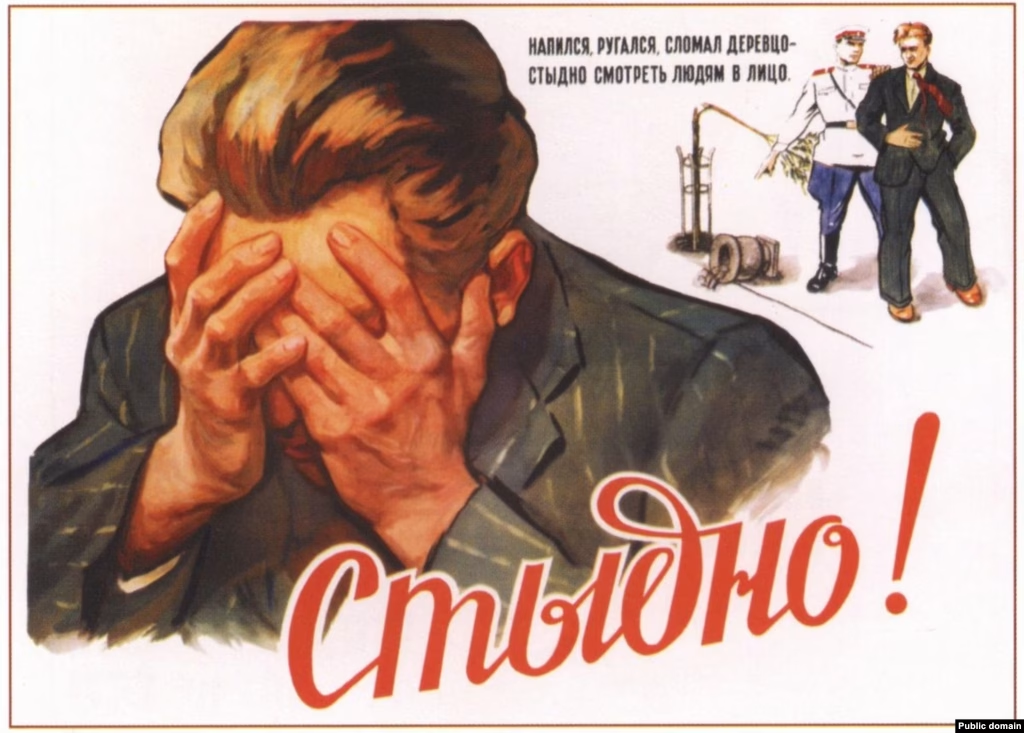
The Soviet state earned a significant portion of its budget from alcohol sales – somewhere around 14% of total state revenues across the USSR. Vodka was mass-produced by state-run distilleries and sold in government-controlled shops. Traditional and regional Baltic beverages (beer, mead, and homemade fruit liquors) were pushed aside in favor of a standardized recipe for Soviet vodka that everyone had to follow. Vodka was considered a staple good, often cheaper than milk, and was (for the most part) readily available.
This is a neat trick: The Soviets moved large numbers of Russian settlers into the Baltics to dilute national identities and create a loyal, Russian-speaking base. All of the labels on the state-manufactured vodka were in Russian, not native Baltic languages. Why teach Russians local languages when you can force everyone else to learn Russian and call it unity?
Alcohol as a Tool of Control

Surreptitiously promoting alcohol use was a deliberate Soviet tactic to pacify and distract the population. Encouraging heavy drinking weakened traditional institutions like the church and national identities, making citizens more compliant and less politically active. It’s difficult to organize a resistance if you’re passed out on the couch.
Another neat trick: the KGB were infamous for using alcohol as a trap. The KGB pushed known dissenters toward alcohol abuse, and then discredited them as drunkards or mentally unstable when they became politically inconvenient.
Alcohol and Baltic Resistance

By the 1970s and 1980s, alcoholism had become a systemic crisis across the USSR, including the Baltics. Rather than addressing the root causes, Soviet authorities decided to portray alcohol use as a moral weakness, which further stigmatized citizens.
Mikhail Gorbachev, having learned absolutely nothing from America’s failed experiment with prohibition in the 1920s, embarked on an anti-alcohol crusade in the mid-late 1980s. The campaign hit the Baltics hard. There were sharp cutbacks in production, so alcohol became much harder to get, legally. This didn’t sit well with the locals who had come to depend on their daily dose of vodka. The reforms led to a rise in illegal distilling (hello, Baltic moonshine) and had the overall effect of fueling anti-Soviet sentiment and delegitimizing Soviet authority in the Baltics.
Samogon (Baltic Moonshine)

Samogon, an unlicensed, homemade spirit, played a surprisingly central role in the resistance culture of the Baltic states during and after Soviet occupation. Samogon was made from whatever fermentable ingredients were available: sugar, grains, potatoes, or even stale bread. While illegal, samogon production was widespread and tolerated to varying degrees, especially in isolated villages where store-bought alcohol was hard to come by. For many, it became not just a drink, but a symbol of autonomy and self-reliance. Alcohol was often the only available antidepressant in a system that preferred tanks to therapy.
As one joke from Soviet times put it:
“We pretend to work, they pretend to pay us—and we drink to forget both.”
Crumbs of Creativity
There were a handful of regional liquors introduced during Soviet occupation. It seems like that would run contrary to Soviet ideology and agenda, but every once in a while the Soviets allowed the Baltics a crumb of creativity. The Soviets allowed “safe” cultural expressions (you just know there was a committee for the determination of safe cultural expressions) that could be branded as regional or folkloric without encouraging nationalism.
But really, just follow the money.
Vana Tallinn

Vana Tallinn was created in 1960 (during Soviet occupation) by Liviko, one of the oldest and most prominent distilleries in Estonia, which was nationalized by the Soviet government. Since Vana Tallinn was produced by a Soviet state enterprise, its manufacturing and sale lined the state’s pockets. It also had export value (even more $$ for the state) and represented minimal political threat.
But what Vana Tallinn did end up representing was a subtle celebration of Estonian culture, history, and identity during a time when such expressions were suppressed. Vana Tallinn helped maintain a sense of national pride, a key element of cultural resistance.
Riga Black Balsam
The recipe for Riga Black Balsam was lost in the early 20th century – no one really knows exactly how. There were only three people on the planet who knew the recipe, and they seem to have disappeared into the political chaos after World War I. Anyway, the Soviets recognized that Riga Black Balsam had sales and export value, and again, minimal political threat, so they allowed the recipe to be recreated. A Soviet chemist, using remnants, rumors, and a little Marxist magic, pieced it back together.

Vana Tallinn and Riga Black Balsam not only reflected the drinking culture of the Baltic states during Soviet occupation, but also highlight the Baltic region’s resilience in developing and preserving distinctive alcoholic beverages under challenging circumstances.
Independence and Intoxication
With independence in the early 1990s came capitalism, and with capitalism came choice. No more standing in line for one brand of vodka – now there were fifty. Supermarkets exploded with options, and so did consumption. Freedom was intoxicating – and no one was in the mood for restraint. The Baltics saw their per capita alcohol use soar into the double digits, often outpacing Western Europe.
📊 Alcohol Consumption in the Baltic States: Then vs. Now
| Country | Soviet Era (Approximate) | Post Soviet Years |
|---|---|---|
| Estonia | 6.9 liters per capita | 10.8 liters per capita |
| Latvia | 7.3 liters per capita | 13.2 liters per capita |
| Lithuania | 6.6 liters per capita | 12.8 liters per capita |
That said, it’s important to note that Soviet statistics are wildly unreliable. During Soviet times, publicizing high levels of alcohol consumption would have contradicted the image of the disciplined, productive Soviet citizen, so the Soviets manipulated any data that was available. These numbers also don’t account for the probably enormous amounts of samogon that were being consumed during Soviet times – and not recorded.
The European Union and New Regulations
After the Baltics joined the European Union, the rest of western Europe got a load of the Baltics’ collective blood alcohol content, and raised an eyebrow. This scrutiny resulted in public health campaigns (Latvia and Lithuania raised their legal drinking age from 18 to 20), stricter advertising laws, reduced retail sales hours, and higher taxes.
Fun, tangentially related fact: the five countries with the highest per capita alcohol consumption in Europe are: Latvia, Moldova, Germany, Lithuania, and Ireland.
Wrapping Up
The Soviet occupation of the Baltic states significantly altered drinking habits and traditions, embedding heavy drinking into the cultural and economic fabric of society. Soviet policies that simultaneously promoted, and attempted to control, alcohol use resulted in complex public health challenges that persist beyond the Soviet era. Still, traditional Baltic drinking customs, and locally produced spirits, became quiet forms of cultural resistance – subtle assertions of national identity that endured even under Soviet rule.
Cheers!


Leave a Reply