
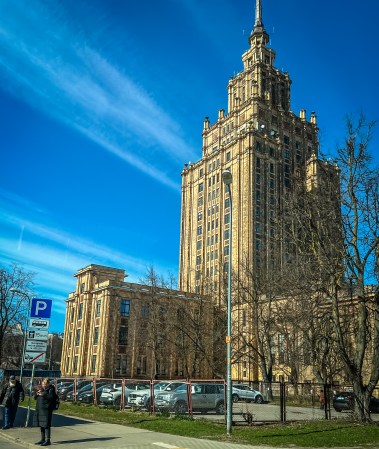
We just returned from a trip to the Baltic states – Estonia, Latvia and Lithuania. There is much to be fascinated by in this corner of the globe, but one thing – instantly and in particular – pulled my focus: Soviet architecture. The ubiquitous, drab, depressing structures that litter the Baltic states.
The basic rule when looking at architecture in the Baltic states is this: if it’s ugly, the Soviets built it.


I’m a child of the 80s. I have always been equal parts fascinated and terrified of the Soviets – the baddest of the bad guys. The movie, “Red Dawn”, was a Gen-X rite of passage. The mascot for my high school? WOLVERINES!! I’ve ducked and covered under many a school desk (which everyone knows is the best way to survive a nuclear attack). And I still have PTSD from watching the movie, “The Day After”.
So that’s my headspace going into the Baltics. Let’s dive in. But first, a map. Because I can’t think without a map.

It’s impossible to understand the Baltics without a foundation of history. Stick with me, I’ll try to be brief.
Pre-Occupation Independence
The story of the Baltics is a story of occupation. After World War I, Estonia, Latvia, and Lithuania declared independence from the collapsing empires of Russia and Germany. From 1918 to 1940, all three Baltic states were independent republics, with their own democratic institutions and cultural identities.
Independence didn’t last long.
First Soviet Occupation (1940-41)
In 1939, Nazi Germany and the Soviet Union signed a devious piece of paper called the Molotov–Ribbentrop Pact, which secretly divided Eastern Europe into spheres of influence. Guess which sphere the Baltics fell under? In 1940, the Red Army occupied and annexed all three Baltic countries. The Soviets installed puppet governments – with carte blanche authority to begin mass deportations, arrests, and executions of political, intellectual, and economic elites. The Soviets sent thousands to Siberian gulags.

Nazi Occupation (1941-44)
In June 1941, Nazi Germany invaded the Soviet Union, including the Baltic region. Initially, some Baltic locals welcomed the Nazis, hoping for liberation from the Soviets. Any optimism was short lived, however, as the Nazis all but annihilated Jewish communities in the Baltics, and many Baltic people were conscripted, killed, or forced into labor camps.
Second Soviet Occupation (1944-91)
The Red Army reconquered the Baltics in 1944, and a second wave of Sovietization began. The Soviets collectivized agriculture, suppressed national identity and language, and continued mass deportations.
One of our guides referred to the Soviet occupation as, “the ugly times”. Although the Soviet gulags had mostly been dismantled by the 1950s, the KGB took up the mantle of terror-based control of the citizenry. Our guide said, “we lived here in a prison, but we didn’t know it was a prison.”
Anything the KGB perceived as anti-Soviet could get you into trouble (harassment, surveillance, interrogation, or worse). You want to display your national flag or speak in your native language? You’d better just do it in your head because if someone sees and reports (because someone always saw and reported), you’re going on the KGB shit-list. Other things that got you into trouble: criticizing the regime, joking about the regime, possessing/reading western (ideologically dangerous) literature, possessing/listening to western music (really ideologically dangerous), going to church, having family in the west, refusing collectivization.
And travel outside the Soviet bloc? Fuhgeddaboudit.
Ugly times.
Independence (1987-91)
During the Gorbachev era, the liberal reforms of glasnost and perestroika gave rise to national movements in all three Baltic states. In 1990–1991, all three republics declared independence. The Soviet Union collapsed in 1991, and the Baltics regained full sovereignty and international recognition.
Legacy of Soviet Occupation
The legacy of Soviet occupation is still deeply felt and politically sensitive. There is no love for Russia in any of the Baltic states. The Soviet occupation(s) are commemorated in museums and memorials throughout the Baltics. But perhaps the most visible reminder of “the ugly times” is Soviet architecture.
The Soviets used architecture as an ideological tool to reshape the region in its own image – erasing legacies of independence and controlling local cultural expression.
Until this trip, I had no idea Soviet architecture had different styles. I thought they all fell under the umbrella category of Ugly Soviet Box.
Stalinist Style (1945 – mid 1950s)
The goal of this style was to showcase the power and glory of the Soviet state. It was monumental and heavily ornamented. And stood in stark contrast to the Art Nouveau and Art Deco influences that had shaped Baltic cities during their brief independence (1918–1940).

The most significant example of Stalinist style that we saw was the Latvian Academy of Sciences in Riga (the photo on the left, below). It’s known locally as “Stalin’s Birthday Cake” for obvious reasons. The photo on the right is Sõprus Cinema in Tallinn. It was built as a palace of propaganda culture in 1955.
The building on the right is another iconic example of Stalinist style architecture – the Sõprus, or friendship, cinema. It was built in 1955 to celebrate the friendship between the USSR and the People’s Republic of China.


Khrushchev Style (Mid 1950s – 1964)
After Comrade Stalin died, Nikita Khrushchev launched a series of significant political and economic reforms (de-Stalinization) aimed at modernizing the Soviet Union, and distancing the regime from Stalin’s legacy of brutality.
As far as architecture was concerned, the reforms led to a rejection of the ornamental excess of Stalinist style, in favor of functional designs that were easy (and quick) to build. In keeping with the theme – they were also ugly.
The whole point of these buildings was to be uniform and utilitarian – stripping away any potential for individuality. Everyone – workers, professionals, even artists – lived in nearly identical conditions. No signs of wealth, status, or personal taste were allowed.
It was also easier to spy on people if they were all living in the same place. Privacy was impossible and everyone was encouraged to spy on their neighbors.
The Soviets also moved a bunch of ethnic Russians into the Baltic states to mix with the national populations and erode their national identities.
Housing was assigned by the Soviet government and usually by your occupation. So if you wanted to leave your apartment, you would also lose your job. Forced dependency.
Our guide told us the easiest way to spot a Khrushchev style house was to look for a structure between 3 to 5 stories and made from white or gray bricks. Why 3 to 5 stories? Because anything taller than 5 stories had to have an elevator. And elevators are a western luxury.
One of the Soviets’ favorite tricks was to build on top of Jewish cemeteries and ghettos. The building on the right in Vilnius was built on top of a synagogue. It’s empty now, while the local leaders try to figure out how best to excavate and memorialize the site.


Brezhnev Style / Brutalism (1960s – 80s)
Brezhnev style (aka Brutalism) houses were much taller, and even uglier.


A large portion of the population in the Baltic states still live in these Soviet legacy “houses”. They can be an affordable option for many. However, they also have no insulation, and outdated and wildly inefficient heating systems, whose cost eats away whatever savings you might have in rent. They also have little to no soundproofing – which was intentional during occupation because how can you spy on your neighbor if you can’t hear them?
KGB Hotels
During Soviet times, if you were visiting from the west (which was very rare – usually diplomats and journalists), you were only permitted to stay at one tightly controlled, and heavily bugged, hotel. In both Riga and Vilnius, these former KGB hotels are now Radisson Blu properties. It’s almost like the Soviets used the same blueprint for both hotels.
Of note: our guides told us that when they cleaned out these hotels after the KGB/Soviets left, they found listening bugs by the hundreds.


Here’s an example of ultra-ugly Soviet architecture. This is the Palace of Concerts and Sports in Vilnius. The Soviets built it on top of a Jewish cemetery and used the headstones to pave a road. Today it sits empty. Our guide told us there were plans to re-develop the site, but as you can imagine, this didn’t sit well with the Jewish community, and now the plan is for it to become a memorial.

What do Baltic people think of these structures today? It’s complicated. There is absolutely no love for the Russians in the Baltics. While most Baltic people view these structures as symbols of “ugly times”, others recognize their historical/architectural significance and advocate for preservation. Some Baltic people see them more as symbols of endurance – and as these buildings are being renovated and repurposed – taking back power from the legacy of the Soviet Union.


Leave a Reply