

How does a country roughly the size of Tennessee end up with world-famous rum, a beer named by its customers, and some of the best coffee on the planet?
Volcanoes, sugarcane, and several thousand years of people who take their corn very seriously.
One of my favorite things to do when we travel is investigate the local drinking situation. I’ll happily spend an hour wandering through a foreign grocery store, examining unfamiliar bottles and trying to determine what the locals are drinking. Ken finds this activity considerably less fascinating, so I usually send him off to climb something.
Guatemala gave me plenty to investigate. There was excellent beer, surprisingly sophisticated rum, a local spirit that tasted like a cavity, and coffee that fundamentally changed my morning routine.
And that’s before we get to the drinks that have been around since the Maya were running the place.
Gallo: The Beer Named by Customers

The national beer of Guatemala is called Gallo, or rooster. It’s immensely popular (think: Guatemalan Budweiser). It was released in 1896 with a rooster on the label, and a perfectly sensible name, Lager Bier. And nobody used it. Not a surprise, really, because as far as beer names go, that one is a real snooze-fest. Local customers found it difficult to pronounce, so they simply asked for “un Gallo,” and the name stuck. The Gallo name went onto the label officially in 1926.
Here’s how I evaluate beer: does it taste like beer? Beer flavored beer. Not fruit beer. Not IPAs (which are undrinkable), not pickle beer, not Sriracha donut beer. You get the idea. Gallo tastes like beer, and I am here for it. It’s a light pale lager, and a super refreshing foil for the Guatemalan heat.
The rooster shows up everywhere in Guatemala — murals, bus stops, sponsorships of anything with a scoreboard.
Gallo is Guatemala. And we bought the Gallo t-shirts.
Quezalteca: Guatemala’s Burning Water

Guatemala’s best-known local spirit is Quezalteca, an aguardiente made from sugarcane. Its name references Quezaltenango, the Guatemalan city associated with the spirit, while its label features the country’s national bird, the resplendent quetzal.
Sidebar: resplendent isn’t just a modifier, it’s the whole technical name of the bird. Basically, it just means magnificent quetzal. And if you’ve seen one, they are indeed magnificent.
Aguardiente is an umbrella term for a whole family of distilled spirits found throughout Latin America. Depending on the country, it might be made from sugarcane, grapes, fruit, or grains. Some versions are flavored with anise or herbs. Others are relatively neutral. Or you could just go crazy and mix bases.
The name literally translates to burning water, although I prefer the slightly less accurate translation: “I am never drinking again.”
Quezalteca tastes fairly neutral to me, somewhere between vodka and basic white rum. I’d read a few articles sounding the alarm about its supposedly terrifying alcohol content. The original Quezalteca is approximately 36% ABV. For comparison, Tito’s vodka is 40%, and Maker’s Mark bourbon is 45%.
They’re distilled spirits. Alcohol is kind of the point.
Just go easy.
Quezalteca: From Cheap Booze to Cocktail Culture
Historically, Quezalteca had something of a reputation as cheap booze. Think Guatemala’s answer to MD 20/20. Not exactly something you’d expect to find on the cocktail menu of a sophisticated bar.
But thanks to clever marketing and some creative bartenders, Quezalteca has found a new audience.
We encountered it at a wedding welcome reception, where the bartenders were making Quezalteca daiquiris.
Those were damn good.
A traditional daiquiri is simply rum, fresh lime juice, and sugar. Substitute Quezalteca for the rum, and you’ve got a Guatemalan variation on a classic. The spirit’s relatively neutral flavor lets the lime take center stage.
And unlike elaborate cocktails requiring fourteen ingredients, a smoking apparatus, and a bartender with a chemistry degree, this is something you could reasonably reproduce at home.
Quezalteca also comes in flavored versions, including tamarind and hibiscus. Tamarind is particularly popular throughout Central America, where its distinctive sweet-and-sour flavor shows up in everything from candy to fruit drinks.
Naturally, I bought a tiny bottle of tamarind Quezalteca. Research, you understand.
Woowwww. That was sweet.
It tasted like a cavity.
Guatemalan Rum: Above the Clouds
Here’s something I didn’t expect: Guatemala makes some seriously interesting rum.
Enter Zacapa.

I’ve never been much of a rum drinker. About the only time I drink rum is when we travel to tropical, umbrella drink places – one of the best drinks I ever had was a fresh banana daiquiri in the Bahamas. But unfortunately, so many rums are characterless (side eye: Bacardi) and wasted in vats of some flavor of “punch” or another.
Zacapa is playing an entirely different game.
What Makes Zacapa Different?
Zacapa uses concentrated sugarcane juice, rather than the molasses commonly used in other rum production. But the really interesting part happens after distillation.
The rum is transported into the Guatemalan highlands, where it ages approximately 7,500 feet above sea level.
Above the clouds.
The cooler mountain temperatures there influence the maturation process. Zacapa also uses a blending and aging method inspired by the solera system, incorporating different types of barrels, including those previously used for American whiskey, Cognac, and sherry.
Now we’re speaking my language.
Here’s another interesting detail: the woven band around Zacapa bottles is inspired by traditional Guatemalan petate weaving. It’s a small but distinctive connection between the country’s craft traditions and one of its best-known international exports.
I bought a small bottle of entry-level Zacapa (Zacapa No. 23) at duty-free on our way out of Guatemala. It was pretty good.
Am I going to become a dedicated rum drinker? Probably not. But Zacapa convinced me that there’s considerably more to rum than keeping pineapple juice company.
There was also a bottle available for approximately $200. Pass. At that price, I’m buying bourbon.
Some loyalties are nonnegotiable.
Cocktails at Hobbitenango: The Mystery Skull
During our ATV adventure, we stopped for cocktails at Hobbitenango, a Hobbit-themed attraction in the mountains above Antigua.
This wasn’t exactly a leisurely afternoon of sophisticated cocktail appreciation. It was more of a let’s-fortify-ourselves-before-driving-these-things-back-down-the-mountain situation.
Our bartender looked approximately twelve years old. Nevertheless, the kid knew what he was doing.

He made us something called the Wizard’s Wand, a highly appropriate Hobbit-themed concoction. Its principal ingredient was a mysterious red liquid poured from a skull-shaped decanter.
Was it rum? Aguardiente? Something extracted from a dragon?
No idea. But it was delicious.
Guatemalan Coffee: An Unexpected Revelation
Guatemala has a serious coffee culture, and Antigua sits in one of the country’s most celebrated growing regions. High elevations, volcanic soils, and varied microclimates produce coffees known for flavors ranging from chocolate and caramel to citrus and spice.

Sounds a lot like wine, honestly.
Unfortunately, I spent years treating coffee the way a small child treats vegetables: disguising its actual flavor with enough cream and sugar to make it unrecognizable.
I didn’t even start drinking coffee until my daughter was born. She considered sleep optional, particularly for other people. Coffee became a survival mechanism.
Cream. Sugar. More sugar.
But while we were in Guatemala, I started experimenting with less sugar. Eventually, I eliminated it altogether.
Revelation.
Coffee actually tastes like something. Different coffees taste like different things.
Who knew?
Well, millions of people, apparently. Including virtually every coffee enthusiast on the planet.
The irony of a retired sommelier discovering that beverages have flavor when you stop disguising them is not lost on me.
I’m keeping my cream, though. Let’s not get carried away.
Coffee and Guatemala’s Complicated History
Guatemala’s coffee story isn’t all beautiful plantations, volcanic soil, and excellent cappuccinos. That cup comes with a bitter backstory. And I’m not talking about the lack of sugar.
In the mid-1800s, Guatemala needed a new cash crop. Its previous moneymaker was cochineal, a red dye made from insects. Yes, bugs. But synthetic dyes were threatening the market, and coffee was looking increasingly attractive.
There was just one problem. Coffee plantations required enormous amounts of land and cheap labor. Indigenous Maya communities had both, and weren’t particularly interested in surrendering either.
So, the government took them.
Following the Liberal Revolution of 1871, President Justo Rufino Barrios, himself a coffee planter, introduced reforms that stripped many Indigenous communities of their communal lands. Much of that land went to wealthy landowners and foreign investors. Labor laws subsequently enabled forced labor and debt peonage, trapping Indigenous workers on coffee plantations.
An excellent arrangement. Provided you owned the plantation.
Coffee became one of Guatemala’s biggest exports, but its success came at an enormous human cost. The resulting inequalities would shape the country for generations.
Today, specialty coffee offers new opportunities for Guatemalan farmers and cooperatives, although challenges remain.
None of this should stop you from enjoying an excellent cup of Guatemalan coffee. But it might make you think a little harder about who grew it.
Beyond the Bar: Guatemala’s Traditional Drinks
Beer, rum, and aguardiente are interesting, but Guatemala’s drinking traditions go back considerably further. Corn and cacao have been important to Maya culture for centuries, and the country’s markets are full of drinks that rarely appear on international cocktail menus.
Some of them have been around considerably longer than Gallo.
Atol: Drink Your Corn
Corn is a big deal in Maya culture. It’s not just a dietary staple; it plays a starring role in Maya creation stories.
Naturally, someone figured out how to drink it.

Atol is a traditional corn-based beverage, usually served warm, with variations flavored with cinnamon, chocolate, or fruit. One popular version, atol de elote, is made with fresh sweet corn. It’s creamy, comforting, and commonly found at markets and festivals.
Think of it as a snack you can drink.
Chocolate Before Chocolate Bars
Long before Guatemala became famous for coffee, the Maya were drinking chocolate. Cacao was serious business — a symbol of wealth, an important part of religious ceremonies, and even a form of currency. Imagine paying your taxes in chocolate.
But forget Swiss Miss and marshmallows. The Maya ground cacao and mixed it with water, sometimes adding chili peppers, and poured it between cups to create a layer of foam. Sugar and milk came later.
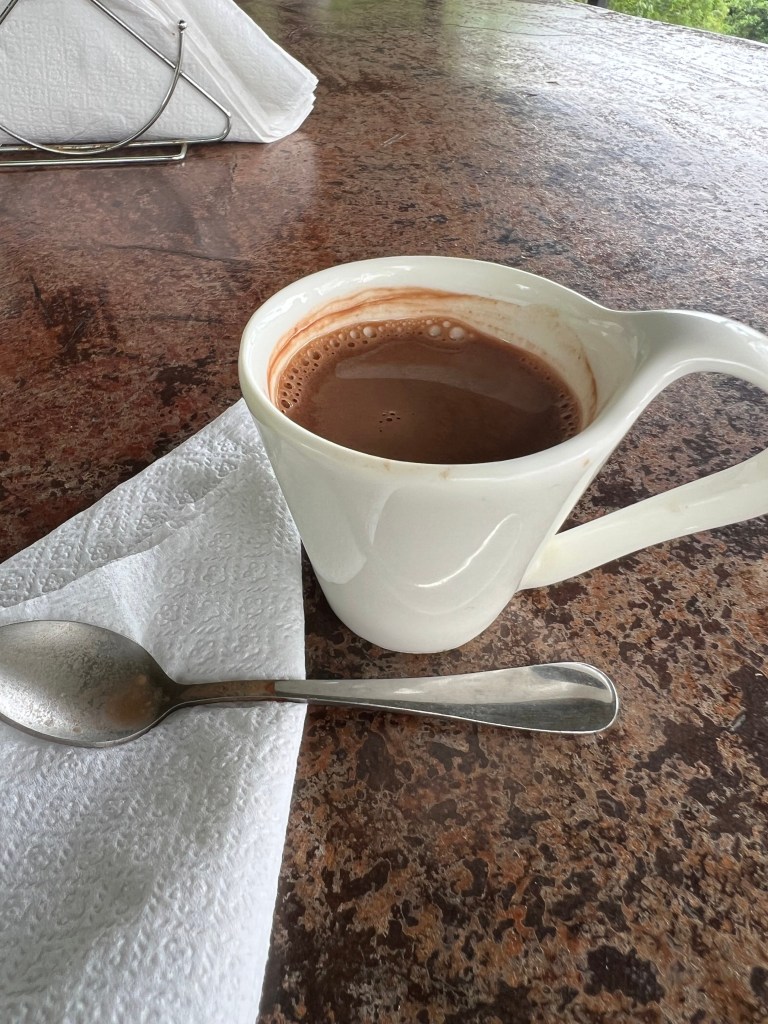
Today, traditional Guatemalan drinking chocolate offers a delicious connection to that history. In Antigua, you’ll find chocolate shops and cacao workshops where you can explore the whole process, from bean to beverage.
Chocolate research is fun.
The Fresco Situation
Guatemala’s frescos are everyday drinks made with fruit, flowers, seeds, and grains. Popular flavors include tamarind, hibiscus (rosa de Jamaica), and horchata. Think homemade juice, not a $19 artisanal mocktail.
Watermelon was my favorite, but I decided to give tamarind another chance. Unlike my ill-fated tamarind Quezalteca, the fresco was delicious. Refreshing, pleasantly tart, and completely free of dental emergencies.

All proof that some of the most interesting drinking happens nowhere near a bar.
What Guatemala Taught Me About Drinking
Guatemala surprised me. I discovered that aguardiente makes a damn good daiquiri, that rum deserves considerably more respect than I’ve historically given it, and that coffee tastes remarkably better when you stop treating it like dessert.
But the really interesting discoveries went beyond the alcohol. Guatemala’s drinks tell stories about Maya traditions, colonial agriculture, complicated history, and everyday life. From ancient cacao beverages to the ubiquitous rooster on practically every beer advertisement, there’s quite a bit of culture in the local drinking situation.
And that’s precisely why I spend so much time investigating it.
Ken can keep climbing mountains. I’ll be in the grocery store.
Salud!


Leave a Reply