
There are countries you can visit knowing almost nothing about them and get along perfectly well.
Germany (and Bavaria in particular) is not one of them.
The best books to read before visiting Germany aren’t necessarily guidebooks. They’re the histories, memoirs, and novels that explain the country behind the castles, beer halls, and elaborate royal palaces.
You can certainly arrive in Munich, drink a beer, eat a pretzel the size of a steering wheel, and have a perfectly lovely vacation. But Germany gets considerably more interesting once you understand why it looks and behaves the way it does.

This is a country where the past isn’t particularly far away. The Holy Roman Empire. Martin Luther. Prussia. Two world wars. The Nazis. The Holocaust. The Berlin Wall. Reunification. All of it has left fingerprints on modern Germany.
And then there’s Bavaria. Because Bavaria is German. But it is also very Bavarian.
Bavaria has its own traditions, dialects, food, architecture, political identity, Catholic heritage, royal family, beer culture, and a general sense that the rest of Germany is perfectly nice, if you like that sort of thing.
Ken and I have been visiting Bavaria since we were kids. My parents used to live there. Ken’s mom is from Germany, and his Opa lived in Munich for 70 years.
We’ve read a lot about Germany over the years, and these are the books I’d put on a Germany & Bavaria reading list.
Best Books to Read Before Visiting Germany and Bavaria
Short on time? Here’s the reading list, organized by what you actually want to understand before you go. Because not everyone wants to tackle 1,000 pages of Third Reich history before boarding a flight.
The Germany & Bavaria Reading List
Ten books worth reading before your trip
| Book | Author | Best For |
|---|---|---|
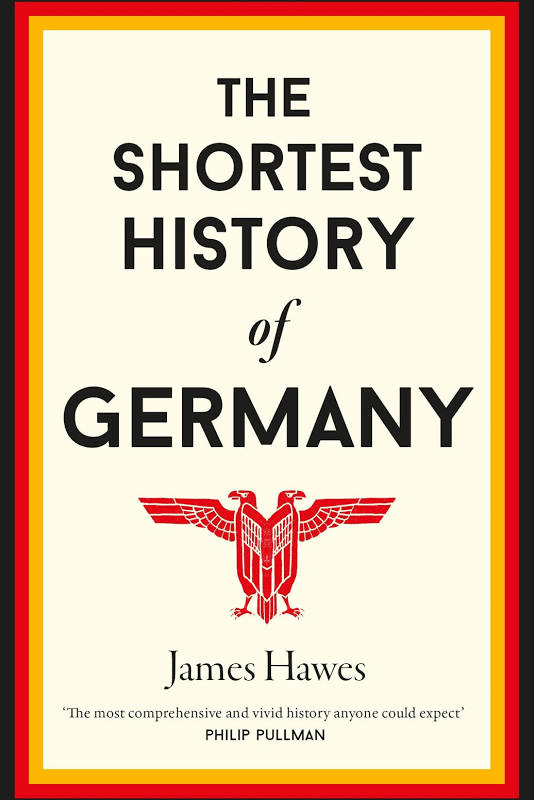
| The Shortest History of Germany | James Hawes | A quick overview of German history |
| Germania | Simon Winder | German history with humor and eccentricity |
| The Wittelsbach Dynasty | Steven Mueller | Bavarian royalty, palaces, and castles |
| In the Garden of Beasts | Erik Larson | The rise of Nazi Germany |
| The Rise and Fall of the Third Reich | William L. Shirer | An in-depth history of Nazi Germany |
| Man’s Search for Meaning | Viktor E. Frankl | Holocaust survivor testimony |
| The White Rose | Inge Scholl | Munich’s anti-Nazi resistance |
| The Book Thief | Markus Zusak | Historical fiction set near Munich |
| The Fox in the Attic | Richard Hughes | Bavaria during the rise of Nazism |
| Munich | Robert Harris | The 1938 Munich Conference |
Best Books About German History
The Shortest History of Germany by James Hawes

Germany presents a problem for travelers interested in history.
There is a lot of it. A lot.
Romans. Charlemagne. The Holy Roman Empire. The Reformation. The Thirty Years’ War. Prussia. Bismarck. World War I. Weimar. Hitler. World War II. East Germany. West Germany. The Berlin Wall. Reunification.
The Shortest History of Germany attempts to explain roughly two thousand years of German history in a remarkably compact book.
Think of this book is your scaffolding, the CliffNotes, as it were.
Then when you encounter references to Prussia or the Reformation or the division of Germany after World War II, you aren’t standing there thinking: I feel like I was supposed to know this.
Germania by Simon Winder

Simon Winder’s Germania: In Wayward Pursuit of the Germans and Their History is my favorite kind of travel preparation: history written by someone who understands that history is often ridiculous.
Winder wanders through German history geographically as much as chronologically, bouncing among tiny principalities, eccentric rulers, castles, wars, monuments, borders, museums, and various historical grudges that everyone involved really should have gotten over several centuries earlier.
This turns out to be particularly useful in Germany because for most of its history there wasn’t really a Germany.
There were kingdoms. Duchies. Bishoprics. Free imperial cities. Principalities. And, for several centuries, the Holy Roman Empire, which Voltaire famously described as neither holy, Roman, nor an empire.
Germany didn’t become a unified nation until 1871. That one fact explains an enormous amount about the country you’re visiting.
Why do the regions still feel so distinct?
Particularly Bavaria. Why does Bavaria regard itself as a country that happens to have misplaced its border guards?
And why are there so many castles?
History.
Germania gives you enough of it to understand what you’re looking at without making you feel as though there will be a quiz afterward.
Best Books About Bavarian History and Royalty
The Wittelsbach Dynasty by Steven Mueller

If you’re spending real time in Bavaria, you need to know about the Wittelsbachs.
They ruled Bavaria, in one form or another, for more than seven centuries. Which is a spectacularly long time for one family to remain involved in anything without someone eventually changing the castle locks.
The Wittelsbach story gives you the background for much of what you’ll see around Munich and southern Bavaria: palaces, churches, art collections, royal monuments and, most famously, the castles of Ludwig II.
Ludwig is the Bavarian king everybody remembers because he built Neuschwanstein, spent staggering amounts of money, adored Wagner, disliked governing, and died under mysterious circumstances in a lake.
As kings go, he was not especially useful.
As tourism infrastructure, however, the man was a visionary.
Understanding the Wittelsbachs turns places like the Munich Residenz, Nymphenburg Palace, and Neuschwanstein from “very large ornate building” into pieces of an ongoing family story.
And Bavaria suddenly makes considerably more sense.
Best Books About Nazi Germany and World War II
In the Garden of Beasts by Erik Larson

Munich is beautiful. Beer gardens. Baroque churches. Markets piled with flowers and produce. The Alps sitting just beyond the city.
Which makes it easy to forget that Munich also played an enormously important role in the rise of Nazism.
Hitler joined the German Workers’ Party there. The Nazi Party was headquartered there. The Beer Hall Putsch happened there. Dachau was established just outside the city in 1933.
Erik Larson’s In the Garden of Beasts is actually centered on Berlin, not Munich, but I still think it’s valuable pre-Germany reading because it captures something history books sometimes struggle to convey:
What did Germany feel like while the Nazis were taking control?
Larson tells the story through William Dodd, the American ambassador to Germany, and his family, who arrived in Berlin in 1933. What makes the book unsettling isn’t simply that we know what happens next.
It’s watching people who don’t.
At first, life continues. There are dinners. Parties. Diplomatic receptions. Affairs. Social events. And around them, almost incrementally, the country changes. Until the changes are no longer incremental at all.
It’s a useful reminder that history rarely announces itself with a title card saying:
THIS IS THE PART EVERYONE WILL STUDY LATER.
Usually people are just trying to get through Tuesday.
The Rise and Fall of the Third Reich by William L. Shirer

William Shirer’s The Rise and Fall of the Third Reich is a classic account of Nazi Germany written by an American journalist who reported from Berlin during the period.
It is also more than 1,000 pages long. I read it in college. It’s not especially light reading.
But if a deep dive into German history genuinely interests you (or you have a really long flight), it’s an extraordinary piece of narrative history.
And Bavaria makes considerably more sense when you understand its role in the Nazi movement.
Man’s Search for Meaning by Viktor E. Frankl

I hesitated about putting a Holocaust book on a travel reading list because “books to read before vacation” and “Holocaust literature” are not categories that sit comfortably together.
We visited Dachau several years ago. I’m glad I went. I never need to go again. But reading survivor accounts matters.
Viktor Frankl was an Austrian psychiatrist and Holocaust survivor who was imprisoned in several concentration camps, including Dachau and Auschwitz.
Man’s Search for Meaning is part memoir and part exploration of how human beings find meaning even under unimaginable circumstances.
It’s a short read, but definitely not an easy one. And it changes the way you enter a place like Dachau. Because Dachau isn’t just another historic site.
People suffered there. People died there.
And knowing even one person’s story makes the scale of what happened harder to reduce to dates and statistics.
Which is exactly the point.
The White Rose: Munich 1942–1943 by Inge Scholl

The White Rose is the true story of Hans and Sophie Scholl, a brother and sister who, along with a handful of other university students, decided they could no longer stay quiet about what Hitler was doing to Germany. Their weapon was almost absurdly simple: paper. They secretly wrote, printed, and distributed anti-Nazi leaflets urging Germans to recognize the regime’s crimes and resist. In February 1943, Hans and Sophie were caught leaving leaflets at the University of Munich. They were arrested, subjected to a show trial, and executed by guillotine just four days later. Sophie was 21. Hans was 24.
The book was written by their sister, Inge, which makes it feel less like a history lesson and more like someone telling you about the people she loved. What gets me is how ordinary they were. They weren’t soldiers or spies. They were college kids who decided that knowing what was happening and saying nothing made them part of the problem. So they said something, knowing exactly what it might cost them.
Prefer watching to reading? Check out Sophie Scholl: The Final Days.
Best Historical Fiction Books Set in Germany and Munich
The Book Thief by Markus Zusak

Sometimes fiction gets you somewhere history can’t.
The Book Thief is set in Nazi Germany and narrated by Death. That sounds like the sort of literary device that could become unbearable almost immediately, but it doesn’t.
The story follows Liesel Meminger, a girl living with foster parents outside Munich during World War II.
The war is seen largely from the perspective of ordinary Germans: children, families, neighbors and people trying to make moral choices inside a society that has become profoundly immoral.
It doesn’t excuse anything — it complicates things, which is more useful.
Because countries aren’t governments.
They’re millions of individual people making millions of individual decisions — some brave, some cowardly, some terrible, and most considerably messier than we like history to be.
Prefer watching to reading? Check out The Book Thief.
The Fox in the Attic by Richard Hughes
An Englishman retreats to relatives in a Bavarian castle in the 1920s while Germany begins sliding toward fascism.

Set in Germany during the messy years after World War I, The Fox in the Attic follows a young English aristocrat who lands in Bavaria just as political extremism is beginning to bubble up. Hughes weaves his fictional story through real events, including Hitler’s failed 1923 Beer Hall Putsch, but the fascinating part is that we’re seeing it without the benefit of hindsight.
Hitler isn’t Hitler yet. He’s just one more angry political agitator in a country full of them—strange, theatrical, and dangerously easy to dismiss. This is a slow, atmospheric book, but I think that’s what makes it so creepy: ordinary people are still going to work, drinking beer, falling in love, and getting on with their lives while something truly terrible is gathering momentum around them.
Read this one before Munich. Those beautiful old beer halls look a little different when you know what was brewing inside them — spoiler alert: it wasn’t beer.
Munich by Robert Harris

September 1938. Hitler. Chamberlain. Mussolini. Daladier.
The Munich Conference.
Set during the tense days of the 1938 Munich Conference, Robert Harris’s Munich turns a diplomatic meeting whose outcome we already know into a surprisingly gripping political thriller. The story follows two former Oxford friends — one now working for British Prime Minister Neville Chamberlain, the other inside the German government — as Britain, France, Italy, and Nazi Germany negotiate over Hitler’s demand for the Sudetenland.
Harris is especially good at putting you inside the rooms, hotels, government offices, and streets of Munich as Europe edges toward war. He also gives Chamberlain’s infamous policy of appeasement more nuance than the usual historical shorthand: not necessarily as naïveté, but as a desperate attempt to buy time and prevent another catastrophic European war.
It’s an excellent pre-Munich read because it makes the city feel less like a backdrop to history and more like the place where, for a few extraordinary days, the future of Europe was being negotiated behind closed doors.
Prefer watching to reading? Check out Munich: The Edge of War.
Why Read These Books Before Visiting Germany?
You’re not trying to become an expert on Germany before you arrive.
You’re trying to give yourself just enough context that when you’re standing in front of a palace, church, beer hall, memorial or suspiciously enormous portrait of a man named Ludwig, you know why it’s there.
That’s the reason I read before I travel. A guidebook tells me what I’m looking at. A good book tells me why I should care.
And Germany rewards knowing the difference.
Prost.
Looking for more books to inspire your travels? Explore all of my travel reading recommendations.
Leave a Reply