
Shanghai is a BIG place.
Roughly 25 million people live within its city limits. By comparison, New York City — the largest city in the US — has about 8 million people.
That should give you some idea of the scale of this place. It’s massive.

We only had a couple of days in Shanghai, so I was on a mission to track down and taste everything I possibly could from a drinks perspective. And there are waaayy too many things to try in two days. I did my best — my choices ranged from ancient to invented approximately eleven minutes ago.
Because that’s Shanghai — a city that seems to be living in several centuries all at once.
Tea Culture: From Teahouses to Cheese Foam
Drinks culture in Shanghai is all about tea. It’s absolutely everywhere. And not just in traditional teahouses, but all over the city’s ultra-modern shopping streets as well.
All true tea — green, black, white, oolong, pu-erh — comes from the same plant, Camellia sinensis.
This surprises people because the tea aisle (at least here in the US) has done an excellent job of making Earl Grey and Dragon Well (Longjing) teas look about as closely related as Chardonnay and tomato soup.
The difference is what happens to the leaves after they’re picked. Dragon Well is an unoxidized green tea. Earl Grey starts with fully oxidized black tea and adds bergamot oil.
And now you know.
One small complication: what the western world calls black tea is called hong cha, or red tea, in China. Western tea is named for the dark color of the dried leaves; Chinese teas are named for the color of the brewed tea.
So that’s a fun way to get confused on a Thursday morning.
But historically, the tea itself was only part of the point.
Teahouse Culture
For generations, the teahouses of Shanghai functioned less like cafés and more like a community nexus — part living room, office, entertainment venue, and neighborhood information hub.
Sure, you went for tea. But you also went to meet your neighbors, conduct business, exchange gossip, and find out what was going on in the city. If something interesting was happening in Shanghai, somebody was discussing it in a teahouse.
One of the best surviving examples of a traditional teahouse in Shanghai is Huxinting, an elaborate building that sits in the middle of a pond at Yuyuan. The building dates to the Ming Dynasty (1368-1644), and became a commercial teahouse in 1855. You get there by walking the Bridge of Nine Turnings (the zig-zag bridge in the photo below), which was designed to frustrate evil spirits — because everyone knows spirits prefer to travel in straight lines. We walked by, but didn’t have tea there. Our guide, Sunny, rolled her eyes, and said, it’s too touristy.
Honestly, it’s like a fossil in the middle of modern Shanghai.

Huxinting was one of the city’s most prestigious places to drink tea, with different rooms and different prices depending on where you sat. Drinking tea there said an awful lot about your social status — you went to see and be seen.
Elsewhere, teahouses were considerably more democratic, and the city was packed with them. The teahouse wasn’t just somewhere Shanghai drank tea. It was somewhere Shanghai happened.
Gongfu Tea: Tiny Cups with Extra Effort
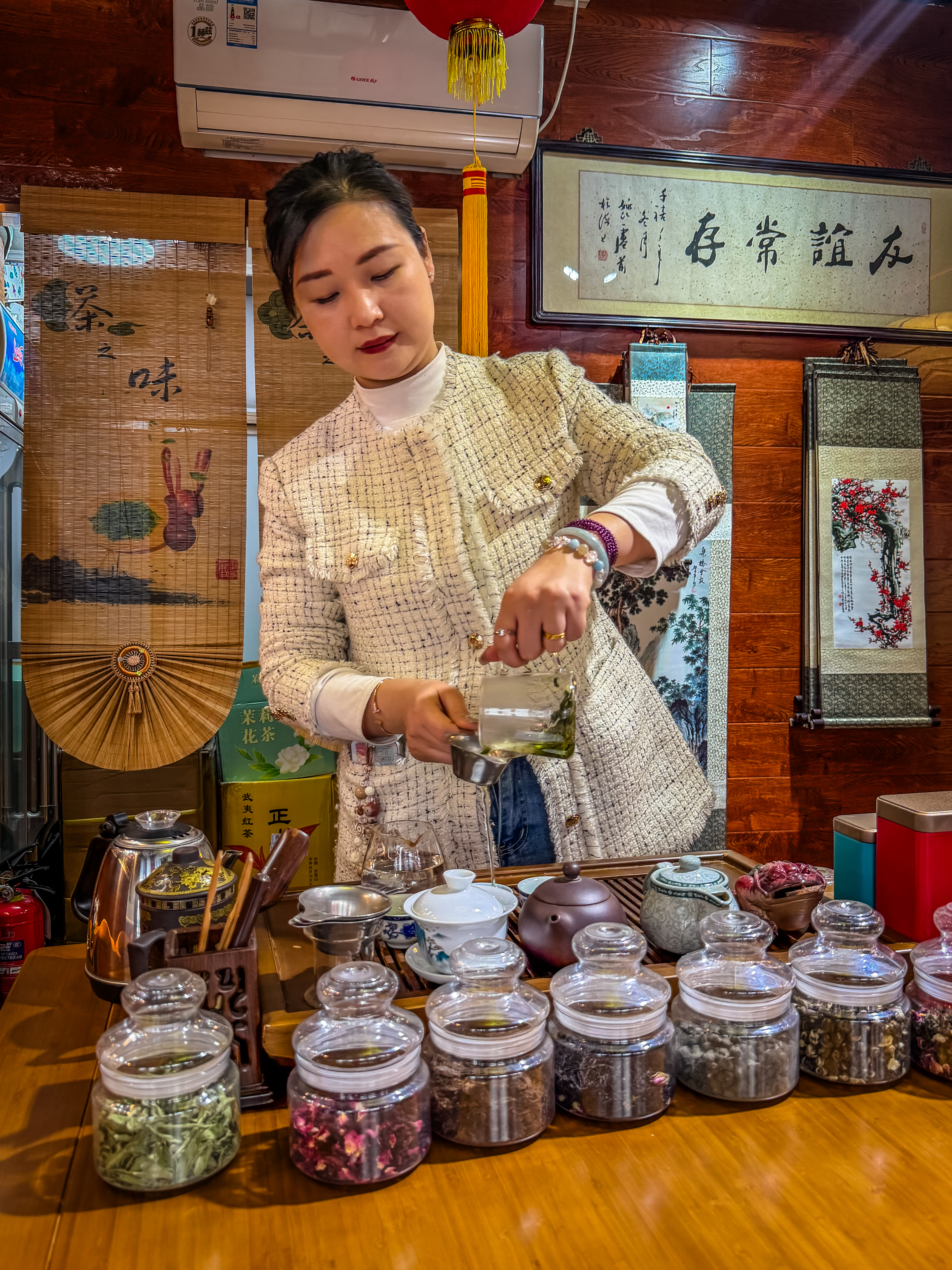
I swear I didn’t plan this, but after we passed on Huxinting, Sunny took us to a traditional teahouse — and we never would have found this place on our own. We waded through piles of sketchy jade and mass-produced tchotchkes to the back of a souvenir shop, then climbed a dark staircase to the second floor like we were sneaking into a Prohibition-era speakeasy.


Once there, we got to participate in gongfu cha (cha is the Chinese word for tea). Gongfu roughly means making tea with skill or effort.
And there is effort in making tea. A lot of it.
The tea is brewed strong in tiny repeated infusions using a small pot, accompanied by enough equipment — pitcher, tongs, strainers, tray, tiny cups — to make your electric tea kettle at home look woefully inadequate.


The same leaves are steeped repeatedly, and you’re supposed to pay attention to how the aroma, texture and flavor change with each infusion. I was fascinated.
Ken was looking for a Diet Coke.
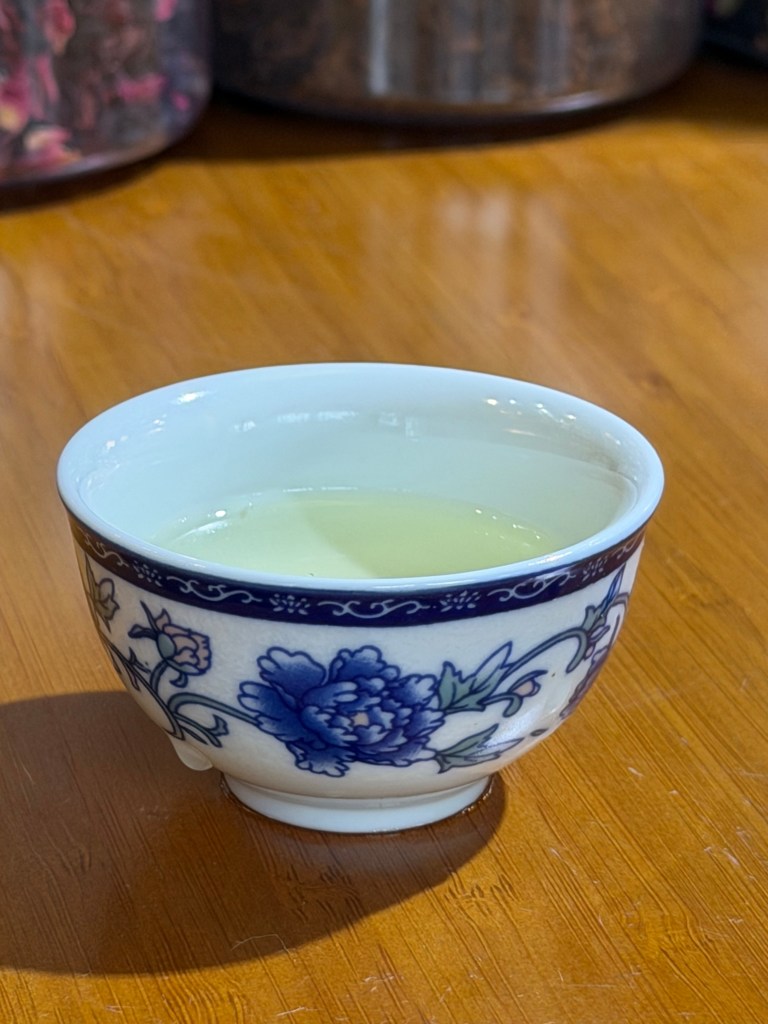
We tasted Dragon Well green tea, jasmine oolong, peach oolong, ginseng oolong, chrysanthemum tea, and pu-erh. I loved everything until we got to pu-erh, which I will explain in a minute.


But Wait, There’s More Tea
After our gongfu cha, we walked for a while and stopped for more tea.
Ken: Is there no Diet Coke in this country?!?
A dozen blocks later, we found an entirely different version of Chinese tea culture — the modern version.
Shanghai built an entirely new tea culture right on top of the old one. And modern Chinese tea has gone completely feral. Milk tea. Fruit tea. Bubble tea. Cheese tea. (Yes, cheese tea.)
Admittedly, they could have given it a better name. Because it’s just green tea topped with a whipped cream cheese, and a pinch of sea salt. And I loved it.
Ken: still looking for Diet Coke.

Drinks like this demolish the tidy Western idea that authentic Chinese tea has to look exactly as it did 300 years ago.
Cultures don’t sit still for tourists. Shanghai doesn’t have to choose between a Ming-dynasty teapot and a plastic cup of cheese foam.
It gets both. On the same street.
Pu-Erh Tea
Pu-erh is China’s great aged tea, produced primarily in Yunnan province, and made to change over time. Hands down, pu-erh was the most unusual tea I tried in China. And not just because of the name — which, btw, no one who isn’t Chinese can pronounce correctly.
Pu-erh tea is a fermented tea. After the leaves are picked and initially processed, microbes — mostly bacteria and fungi — are allowed to get involved. They slowly transform the tea, changing its flavor, aroma and color over time, much the way microbes help turn milk into cheese or grapes into wine.
Pu-erh can be sold as loose tea, but most of the time it’s compressed into large discs or cakes that look remarkably like giant hockey pucks.


Styles of Pu-erh
In case you ever find yourself face-to-face with a puck of Pu-erh — there are two broad styles. Sheng, or raw pu-erh, ages naturally over years or even decades, gradually becoming darker, softer and more complex. Shou, or ripe pu-erh, uses an accelerated fermentation process developed in the twentieth century to produce some of those aged characteristics much faster.

Aged pu-erh tea can get expensive. Very expensive. I did some searching online and found one cake of pu-erh for sale for $3,800. Yes, earth dollars. I am not making this up. See for yourself.
There are people in the world who will pay thousands of dollars for what is essentially compressed mulch.
So, the taste. Good pu-erh is some combination of earthy, woody, and leathery. Bad pu-erh can taste like a wet basement. The one we tasted reminded me of a leather couch in a wet basement. I won’t say I hated it, but it wasn’t my cup of tea, per se.
But I bought all of the ginseng tea.
Baijiu: China’s Contribution to Clear Liquor
If tea is Shanghai’s quieter side, baijiu is the moment someone at dinner stands up holding a tiny glass and announces that you’re all about to become much better friends.
Baijiu is China’s entry in the East Asian lineup of clear spirits (Japan has shochu, Korea has soju). Usually made from sorghum, it’s fermented and distilled using methods that bear very little resemblance to Western spirits production.
It also tastes like absolutely nothing in the Western liquor cabinet.
Depending on the bottle, you might get tropical fruit, fermented grain, flowers, soy sauce, blue cheese, nail polish remover, or something vaguely agricultural.
I got nail polish remover.

But focusing on the flavor misses the point. In China, baijiu isn’t simply a drink.
It’s social infrastructure.
It’s also the most-consumed spirit on Earth by volume. Not the most-consumed spirit in China. And not the most-consumed spirit in Asia.
The most-consumed spirit on Earth.
You’d never guess it from walking into an American liquor store, though, because almost all of it is consumed in China. Tito’s will never have to worry about baijiu fighting it for shelf space in the US.
Ganbei: The Two Syllables You Should Fear
At a traditional Chinese banquet, drinking reinforces relationships and hierarchy. Toasts matter. Who proposes the toast matters. Who drinks with whom matters.
And then someone stands up and says gānbēi! Literally: dry cup.
Or, more ominously: Bottoms up!
This is followed by more standing, more toasting and, inevitably, more baijiu. The drink itself isn’t really the point. The ritual is. A toast can signal respect, hospitality or simply a desire to strengthen the relationship around the table.
So, if your host pours you baijiu, remember that what’s being offered is more than a drink.
And probably don’t announce that it tastes like nail polish remover.
Huangjiu: The Other Ancient Chinese Alcohol
If baijiu is China’s formidable banquet spirit, huangjiu is its quieter, older cousin.
Literally yellow wine, huangjiu is fermented, but not distilled. The best-known style comes from Shaoxing, about 120 miles southwest of Shanghai, where it’s been produced for centuries.


If you’ve heard of Shaoxing wine before, it’s probably because it’s fundamental to regional Chinese cooking. But good huangjiu is made for drinking, too. It has a nutty, savory and slightly oxidative flavor — somewhere in the neighborhood of dry sherry.
It’s delicious.
And unlike baijiu, it didn’t make me wonder if I could use it to strip varnish off furniture.
Huangjiu is ancient, culturally important, surprisingly complex — and virtually absent from the average American liquor store. Meanwhile, we have approximately 47 varieties of birthday cake flavored vodka.
Civilization is complicated.
Beer: You Can Thank the Germans
Tsingtao. That’s it. That’s all you need to know.
I’m kidding. Mostly. Tsingtao is the Chinese beer most Americans recognize. It was founded in Qingdao in 1903 during the period of German presence there, which explains the heavy German fingerprints on Chinese brewing history.


What the heck were the Germans doing in China in 1903?
In the late nineteenth century, European powers were busy carving out pieces of China for their own commercial and military interests. Germany wanted in. And in 1897, after two German missionaries were killed in China, Germany used their deaths as justification to seize the area around Kiaochow Bay. The following year, it forced the Chinese government to lease the territory to Germany for 99 years.
The Germans then set about building a little piece of Germany on the Chinese coast — complete with roads, railways, European-style buildings, and naturally — beer. German and British businessmen founded the brewery that became Tsingtao in 1903.
Germany lost control of the territory during World War I. The brewery, however, stayed.
More than a century later, Tsingtao remains China’s most recognizable beer brand.
Tsingtao is a wonderfully strange little historical artifact hiding in plain sight — crack open a bottle in Shanghai and you’re drinking the residue of imperialism, international trade, and German brewing culture.
Coffee: Things Have Gotten Out of Hand
If tea tells you something about old Shanghai, coffee tells you quite a bit about the new one.
Shanghai now has more than 9,000 coffee shops, reportedly more than any other city in the world. There are tiny independent cafés, enormous chains, and an apparently endless competition to see how far you can push a cup of coffee before it ceases to qualify as coffee.
Case in point: the green-pepper latte. Yes. Green pepper coffee. But Shanghai took it one step further and committed to the presentation:

Nope. I’m not even a little bit curious about this one. I can’t stand green peppers.
[Timeout for a brief rant.] Green peppers are culinary squatters. Put three microscopic pieces of green pepper on a pizza and congratulations: you now have a green pepper pizza. Remove them? The pizza remembers. The cheese remembers. Your fingers remember. There is no such thing as a little green pepper. Once it’s in the dish, the entire dish has been green-peppered. Forever.
Hot Water: No, Really
Finally, we need to discuss one of China’s most ubiquitous beverages: hot water. Not tea. Hot water. It’s everywhere. Our guide carried a thermos of it. At lunch, our waiter brought us hot water before the meal.

The habit has roots in ancient, traditional Chinese medicine, where warmth is associated with digestion and bodily balance, but it also has a practical history. Boiling water became an important defense against disease in the nineteenth century, and government hygiene campaigns in the 1950s helped turn public-health advice into cultural habit.
Headache? Hot water. Stomach ache? Hot water. Tired? Hot water. Cold? Obviously, hot water.
As an American, I find this baffling. We expect water to arrive with enough ice to preserve a small mammal.
As it should be. 😉
The Drink Is Rarely Just the Drink
What struck me most about drinks culture in Shanghai was how often the glass in front of me told me something larger about the city.
Tea is patience, ritual and hospitality. Baijiu is reciprocity and relationships. Huangjiu connects today’s dinner table to centuries of regional food culture. And the explosion of elaborate tea shops and coffee tells you something else: Shanghai isn’t trapped inside its traditions. It’s constantly renegotiating them.
A traditional teahouse sits a few streets from a mall selling drinks through an app. A formal baijiu banquet coexists with grabbing a green pepper latte on the way to work. Shanghai is ancient tradition layered over revolutionary history, layered over hyper-modern consumer culture. Sometimes within the same three blocks.
You could start with the treaty port, the Bund, and a century of reinvention. Or you could just sit down at a table and pay attention to what everyone is drinking.
干杯 (Gān bēi)


Leave a Reply