
Sake has been part of Japanese life for more than 2,000 years, which makes determining exactly who invented it a little like identifying the first person who looked at grapes and thought, I wonder what happens if I leave these unsupervised in a bucket.
What began with rice, water and fermentation became something much bigger than Japan’s answer to wine. Sake found its way into Shinto shrines and imperial courts, survived wars and rice shortages, became an industry and a source of tax revenue, and evolved into a remarkably precise system of brewing, classification and ritual.
And somewhere along the way, it became a surprisingly good way to understand Japan itself.
Hierarchy. Reciprocity. Ritual. Craftsmanship. An almost obsessive attention to detail. And the idea that how, where and with whom you experience something matters nearly as much as the thing itself.
You can find all of it in a tiny cup of fermented rice.
Sake explains Japan.
First Things First: Sake Isn’t Rice Wine
Sake gets called rice wine all the time, which is understandable, but technically rather unhelpful. It’s a little like calling a dolphin a fish: everyone knows roughly what you mean, but biologically, we have problems.
The ingredients in sake are simple:
- Rice
- Water
- Koji mold — converts the rice’s starch into sugar.
- Yeast — converts that sugar into alcohol.
Wine starts with grapes that already contain fermentable sugar for yeast to work with. Rice has starch instead, and yeast can’t do much with starch on its own.
That’s where koji comes in.
Koji is rice inoculated with a mold called Aspergillus oryzae, which sounds like something you need to take antibiotics for but is actually one of the great workhorses of Japanese food culture. It’s also essential to miso, soy sauce, mirin and other fermented foods.
In sake brewing, koji produces enzymes that convert rice starch into sugar while yeast simultaneously turns that sugar into alcohol. Sake production is much closer to brewing than winemaking.

Sidebar: In Japan, the word sake actually means alcohol in general. What we call sake, the Japanese call nihonshu. Use that word and you will look slightly less like a tourist.
Slightly.
A Brief History of Sake (without turning the post into The Cambridge History of Japanese Alcohol)
Alcohol made from rice has existed in Japan for more than two thousand years, although nobody can point to one moment and say, “There. Sake.”
The earliest written references to drinking in Japan come from Chinese texts dating to around the third century, which describe people drinking alcohol at communal and funerary gatherings.
Early sake, however, would have borne very little resemblance to the elegant sake of today. Back in the third century, people chewed cooked rice and spat it into a communal container. Enzymes in human saliva converted the starch into sugars, and naturally occurring yeasts eventually fermented it.
Yummy.
Sake Was Originally for the Gods
The important thing isn’t simply that ancient Japanese people figured out how to make alcohol. It’s why they made it.
Sake became deeply connected to Shinto, Japan’s indigenous religion. Rice was sacred—a gift associated with the gods and the harvest—and sake made from that rice became a way of communicating with the divine. Priests offered it to the kami, the spirits or deities of Shinto, in exchange for abundant harvests, prosperity and protection.
Long before sake became something you ordered with dinner, it was something you gave to the gods. And that relationship never disappeared.
Walk through almost any major shrine in Japan and you’ll likely see stacks of beautifully decorated sake barrels. I initially assumed these were for decorative purposes only.

They are not.
The barrels represent offerings from sake breweries. But even that exchange reveals something distinctly Japanese: sake is built around reciprocity. Brewers give sake to the shrine; the shrine performs rites for the brewery’s prosperity in return. The same principle follows sake to the table. You don’t traditionally pour your own cup—you pour for the person beside you, and they pour for you.
Sake turns drinking from an individual act into a relationship.
From Imperial Courts to Modern Sake
Sake spent its early centuries following power and money. What began as an offering to the gods became a drink of the imperial court, then a specialty of temples and shrines, where brewers refined the process. By the 1600s, Japan was unified, cities were booming, merchants had money, and Edo (modern Tokyo) was one of the largest cities in the world.
And all those people were thirsty.
Commercial brewing exploded, regional centers like Nada became famous, and the government discovered one of civilization’s more enduring truths: alcohol is extremely convenient to tax.
The Meiji era brought modern science to brewing — better yeast, fermentation control and rice polishing — but war brought rice shortages and decades of cheap, mass-produced sake. Then postwar Japan discovered beer, whisky, wine, cocktails and canned chuhai, and sake consumption plummeted. Its revival came through quality: small breweries, regional styles and increasingly refined premium sake.
Yet after two thousand years of emperors, monks, merchants, tax collectors, scientists and changing tastes, sake still serves its original purpose. It’s offered at shrines, shared at weddings and poured for the person beside you.
Make it, offer it, share it, drink it together. Some traditions don’t need improving.
Which brings us from two thousand years of Japanese history to the considerably more immediate question: Which sake are you supposed to buy?
To answer that, you need to understand rice polishing.
The Key to Sake is Rice Polishing
Rice polishing is one of the keys to understanding modern sake. Before brewing, brewers polish away the outer layers of the rice grain, stripping out proteins and fats that would otherwise push the flavor toward heavier and more savory.
Think of polishing as refinement. More polishing tends to produce something lighter, more aromatic and more delicate. Less polishing tends to produce something richer, earthier and more savory.
But — and this matters — more polishing doesn’t automatically mean better sake.
It’s a style choice as much as a quality marker.
Hierarchy is the national love language of Japan, and sake is no exception. Its classifications extend right down to the percentage of a rice grain milled away. Even a grain of rice knows exactly where it ranks.
The best visual I’ve seen to explain rice polishing and classification is this, from Urban Sake:

The Sake Categories to Know
Junmai — Pure rice sake. No added distilled alcohol. Generally fuller-bodied and food-friendly. The reliable friend who shows up to help you move.
Honjozo — A small amount of distilled alcohol is added during brewing, not simply to increase alcohol but to create a lighter, more aromatic style. More alcohol can, strangely enough, result in a more delicate drink. Sake enjoys making things difficult.
Ginjo — Made with more highly polished rice and special fermentation techniques. Generally lighter, more fragrant and fruitier than you’d expect from something that started as a bowl of rice.
Daiginjo — Even more highly polished and typically delicate, fragrant and refined. Often expensive. Frequently beautiful. The sake equivalent of a hotel minibar where you deliberately don’t check the prices.
Important and confusing: Junmai Ginjo and Junmai Daiginjo exist too. The Junmai tells you no distilled alcohol was added; Ginjo or Daiginjo tells you about the brewing style and rice polishing.
Japan does not believe in making this easy for you.
Nigori — Cloudy sake containing fine rice solids left after filtration. Often richer, creamier and sometimes sweeter than clear sake. Think of it as sake that decided transparency was overrated.
On a Personal Note
All of that is a lot to absorb standing in a liquor store aisle. I know, because that’s exactly where I started. I’ve spent more than twenty-five years studying wine and spirits, but until recently, sake was one of the biggest blind spots in my education.

Back when I earned my sommelier certifications, the training was almost entirely Western-focused. That was the benchmark. Sake was an afterthought. Thankfully, that’s changing now, because sake is a drink that deserves respect.
My prior experience with sake began and ended at Japanese restaurants — the thimble— full of sake that shows up at the end of the meal, warm and forgettable, more ritual than revelation. I knew there had to be more to sake than that.
Before our trip to Japan, I wanted some kind of foundation to build on, and the only foundation that’s ever worked for me is tasting. So I went to my favorite liquor store (for local readers — MacArthur Beverages in DC) and asked for recommendations.
They sent me home with three bottles: a Junmai, a Junmai Ginjo, and a Junmai Daiginjo (more on these in a minute).
I expected to like them.
I didn’t expect to love them.
All three were elegant, nuanced, food-friendly, and unlike anything I’d tasted in my previously limited experience with sake. Delicious.
What a Difference a Place Makes
Most drinks are actually enhanced by place. Champagne tastes better in Champagne. A Negroni tastes better in Italy. And I remain convinced that German beer undergoes some sort of magical transformation when consumed outdoors at a communal table in a biergarten in Munich.
Sake is no exception.
Maybe it’s the setting. Maybe it’s the food or the company. Or maybe drinks simply make more sense when you enjoy them in the culture that created them.
The Japanese have a concept called mono no aware (物の哀れ) — an awareness of the fleeting nature of things and the particular beauty of experiencing them in their moment. Sake somehow makes sense through that lens. The same bottle can become a different experience depending on its temperature, the season and the company.
At home, I appreciated sake. In Japan, I understood it.
How to Order and Buy Sake Like a Pro
At the izakaya in Tokyo, I made the mistake of ordering sake like I knew what I was doing.
The server smiled and asked, “Junmai? Ginjo? Daiginjo?”
Ah.
This was apparently not a yes-or-no question.
I leaned over to our guide, Izumi, and whispered, “Which sake do I want?” Without hesitation, he pointed to a Junmai Ginjo. “Good balance,” he said. “Very Japanese.”
It turned out to be the perfect recommendation.
More delicate and aromatic than the Junmai styles I’d tried, but not quite as ethereal — or expensive — as some Daiginjo.
Just delicious.

Even better, the bottle we selected happened to come from Izumi’s hometown.
His face lit up when he discovered it.
That moment explained something about sake that a classification chart never could.
This isn’t simply a beverage category.
It’s local.
Personal.
Tied to place.
What Should You Buy First?
There are dozens of sake styles, and staring at a wall of bottles covered in Japanese characters can be intimidating. Don’t worry about learning regions or breweries. Or learning Japanese. Start with style.
Here’s the trick: Think of the names as two separate pieces of information. “Junmai” tells you what’s in the bottle (pure rice, with no added distilled alcohol), while “Ginjo” and “Daiginjo” tell you how much the rice was polished before brewing. Put them together, and a Junmai Ginjo is simply a highly polished sake made without any added alcohol. A Junmai Daiginjo is the same idea, but with even more highly polished rice.
If you’re buying sake for the first time and have absolutely no idea where to begin, I’d give you exactly the same advice Izumi gave me:
Buy a Junmai Ginjo.
It’s the Goldilocks bottle — refined enough to show you what premium sake can be, but approachable enough that you can stop analyzing and start drinking.
I doubt you’ll regret it.
Sake: Hot or Cold?
I used to think this was easy. You serve cheap sake warm and good sake cold. But that’s an oversimplification.
Sake can be served chilled, at room temperature, or warm, and temperature changes the way it tastes: delicate, aromatic Ginjo and Daiginjo styles stay brightest chilled, while richer Junmai and Honjozo styles can turn wonderful gently warmed, the heat softening the acidity and coaxing out savory, umami depth.
So the better rule isn’t good sake equals cold — it’s that delicate sake wants to be cool, and richer sake may want some warmth.
Tiny Cups, Big Consequences
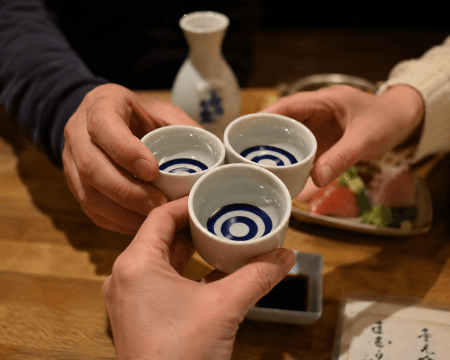
Traditional sake is served from a small tokkuri (carafe) into tiny ochoko cups.

The tiny pours help maintain temperature. They also reinforce one of the central rules of Japanese drinking culture: you don’t pour your own drink. You pour for everyone else. The cups are beautiful, and I may or may not own multiple sets.
But don’t let those tiny cups fool you. Somewhere around your ninth refill, the mathematics of “tiny” begins to break down.
The Final Sip
Before visiting Japan, sake was something I respected.
After visiting Japan, it’s something I keep in my house.
Every time I open a bottle, I think about Izumi grinning when he realized we’d accidentally ordered sake from his hometown.
That moment makes more sense to me now.
Because sake isn’t simply fermented rice. It’s rice farmers and mountain water. Shinto shrines and imperial banquets. Buddhist monks and merchant ships. Microbiology labs and polishing machines. Wartime shortages and tiny family breweries trying to survive another generation.
It’s more than two thousand years of Japanese history that somehow ended up inside a bottle.
It turns out I wasn’t missing a drink. I was missing an entire tradition.
Kanpai 乾杯 🍶


Leave a Reply