

If you want to understand a country, don’t just visit its museums.
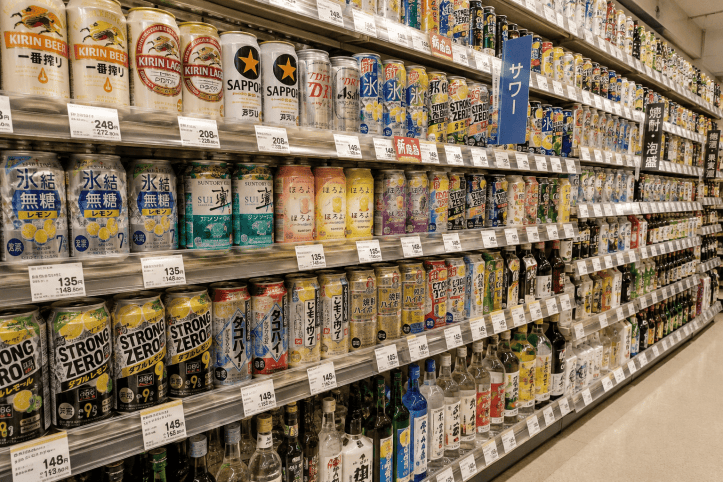
Go stand in the drinks aisle of the nearest grocery store.
Watch what everyone else is drinking. Order something you’ve never heard of.
I’ve spent more than twenty years studying wine and spirits, and whenever we travel, I am obsessed with what I call drinks culture – what a country’s drinks reveal about its history and culture.
I’ll happily order half the drinks menu just to taste things. I can lose an hour (or more) wandering the beverage aisle of a neighborhood grocery store like I’m conducting anthropological research. Ken does not share this enthusiasm, so I usually send him off on a side quest so I can browse in peace.
Despite years of study, my sommelier education was overwhelmingly Western in focus. Bordeaux? Covered. Scotch? Extensively. Japanese whisky? Absolutely. But sake and shochu – two drinks that tell you far more about everyday life in Japan – barely registered on the syllabus.
So I went to Japan with a whole lot of curiosity and a desire to fill in some knowledge gaps.
Two weeks later, I came home convinced that the most interesting thing I learned wasn’t about sake, shochu, or matcha.
It was about Japan itself.
Because once you start paying attention to what people drink – and how they drink it – you begin to notice something bigger. Every glass comes with a story. And in Japan, those stories are about craftsmanship, community, precision, ritual, and a level of thoughtfulness that feels almost unnatural to a westerner.
PART ONE: DRINKING TOGETHER
The Nomikai in Japan
In most Western drinking cultures, alcohol is personal. You have your drink, I have mine, and we happen to be in the same room.
In Japan, drinking is communal.
The concept is called nomikai – officially optional, unofficially mandatory – drinking gatherings among colleagues. Think Western happy hour, except with actual social architecture behind it. Japanese workplaces run on hierarchy – nearly every interaction has a chain of command baked in. But at a nomikai, that structure loosens.
Nothing flattens a hierarchy – or a tongue – like a drink or seven.

Supervisors use nomikai as a way to evaluate the trust and loyalty of their employees. And here’s the very Japanese downside: refusing an invitation to nomikai, or refusing a drink from a superior once you’re there, can be viewed as disrespectful. And no one in Japan ever wants to be seen as disrespectful.
I’ve always subscribed to the idea that getting drunk at an office party is generally a career limiting move. Which made Japan’s nomikai culture especially fascinating. Alcohol isn’t just tolerated – it’s expected as part of building relationships at work.
The Ritual of Pouring for Others
The most revealing aspect of Japanese drinking culture is also one of the simplest: you don’t pour your own drink. Instead, you pour for the person beside you, and they pour for you.
You have one job: watch your neighbor’s glass.
On the surface, this looks like etiquette. In practice, though, it reflects something deeper. Keeping an eye on another person’s glass and refilling it before they have to ask is a small but deliberate act of awareness and consideration. Drinking becomes a shared experience rather than an individual one.
Sidebar: this system can also result in drinking considerably more than you planned. You’ve been warned.
PART TWO: WHAT JAPANESE PEOPLE DRINK
Japanese Beer: Solid & Beer Flavored

Although sake is the drink that’s internationally associated with Japan, beer is the country’s everyday drink. Japanese lagers are genuinely good – crisp, clean, and (very important) beer flavored – a refreshing reminder that not every beer needs to taste like someone accidentally dry-hopped a watermelon.
Generally speaking, Japanese beer is often brewed with rice, and a little less malt than many European or American beers. The result is a lighter body, a crisp, dry finish, and a beer that’s designed to refresh rather than challenge you. Like so many things in Japan, it’s subtle, balanced, and quietly precise rather than loud or attention-seeking.
Asahi, Sapporo, Kirin, and Suntory (yes, the whisky people) are all major players. Asahi Super Dry is the most popular beer in Japan.
Worth noting: the craft beer scene is growing rapidly, particularly in Tokyo and Osaka. If you see a tap list with Japanese craft options, and you enjoy the experimental side of beer, order one. I saw everything from yuzu wheat ales to black sesame stouts at the izakaya. Myself, I’ll stick with the Asahi Super Dry.
Sake: More Than Japan’s National Drink
Beer may dominate everyday life, but sake carries ceremonial weight. It’s offered at Shinto shrines, shared during celebrations, and treated with the same quiet respect that Japan gives so many handmade things. Even the ritual of serving it reinforces community: you don’t pour your own drink. You watch everyone else’s cup instead.
One afternoon, our guide Izumi took us to an izakaya – a noisy Japanese pub where conversations bounce off the walls, tiny plates of food keep appearing, and everyone’s glass somehow stays full.
On Izumi’s recommendation, we ordered a Junmai Ginjo sake.
Izumi glanced at the bottle and immediately lit up.
Ah! This sake was made in my hometown.
He wasn’t excited because it was famous or expensive. He was excited because it was his. For the next few minutes he told us about the brewery, where it was located, and why he was so happy we’d ordered it. Then we all raised our tiny cups and drank.
Note the tiny cups. Those aren’t just practical. They quietly encourage conversation. Someone notices your cup is empty. Someone else reaches for the bottle. The afternoon becomes less about what you’re drinking and more about sharing an experience.
Note: Izumi was a little too good at refilling our tiny cups. Somewhere around your ninth cup of sake, things start getting really philosophical.


It was one of my favorite moments of the trip.
Not because it was the best sake I tasted – although it was excellent – but because it reminded me that drinks are never just drinks. They’re places. They’re memories. They carry the pride of the people who make them.
Before arriving in Japan, I thought of sake as another category of alcohol to learn. Once I got there, I realized sake isn’t simply Japan’s national drink. It’s woven into the country’s cultural DNA.
Stay tuned: Want to know the difference between Junmai, Ginjo, and Daiginjo—or how to order sake confidently in Japan? Read my complete Beginner’s Guide to Sake.
Shochu: Japan’s Everyday Spirit

If sake carries ceremonial prestige, shochu feels more like Japan’s dependable everyday companion.
Before our trip, someone described shochu as, Japanese vodka, which immediately lowered my expectations (I’m just not a vodka girl). Fortunately, that’s wildly inaccurate.
At the izakaya in Tokyo, I made the mistake of ordering a shochu like I knew what I was doing. And then our server asked what kind of shochu I wanted, and how I’d like it served.
Ooooh. Unexpected question.
And apparently, there are dozens of possibilities. I leaned over to our guide, Izumi, and whispered, “What kind of shochu do I want?”
He suggested a sweet potato (imo) shochu with soda on the rocks. It was clean, earthy, and completely unlike vodka. I enjoyed it, but not as much as I enjoyed the sake.
What struck me most wasn’t the flavor, though. It was how casually shochu fit into everyday life. While sake often appears at celebrations, ceremonies, or special meals, shochu is the drink people reach for after work. Depending on the region, it might be served over ice, mixed with soda, diluted with hot water on a cold evening, or paired with dinner at the neighborhood izakaya.
Stay tuned: If you’d like to learn what shochu actually is, why it isn’t Japanese vodka, and how the different styles compare, read my complete guide to Japanese shochu.
Japanese Whisky: Scotch, Perfected

I should probably confess something before we go any further.
I hate Scotch.
It’s the peat. My palate reacts to peat the same way toothpaste reacts to orange juice.
Ironically, that made me exceptionally good at blind-identifying Scotch during my sommelier exams. One sniff and I’d think, yep, there it is . . . a campfire in a field full of wet sheep. And I’d happily write the tasting note from memory.
So, Japanese whisky presented me with a bit of a dilemma – because it’s based entirely on the blueprint of Scotch.
In the early 1900s, Suntory founder, Shinjiro Torii, wanted to create Japan’s first great whisky. So, he borrowed Scotland’s methods and then did something quintessentially Japanese: obsessed over refining every tiny detail.
The result is one of the world’s most respected whisky traditions. Rare bottles regularly sell for thousands of dollars, and the most sought-after releases can fetch tens – or even hundreds – of thousands at auction.
Most locals, though, aren’t sipping rare collector bottles. They are drinking whisky highballs – Japanese whisky, soda water, and ice. I saw this show up on restaurant menus across the country.
Japanese whisky is generally more delicate than many Scotch whiskies, and not every bottle is heavily peated. But enough of that smoky DNA survives that my palate immediately waves a white flag. If aromas of campfire, sea spray, and smoldering logs make you happy, you’re going to love it.
Me, I’ll be over here with my bourbon.
What fascinated me wasn’t whether I enjoyed Japanese whisky. It was that even a spirit borrowed from another country somehow became unmistakably Japanese. Precision. Patience. Craftsmanship.
By this point in the trip, I was beginning to suspect that Japan doesn’t really make drinks differently. It does everything differently.
PART THREE: BEYOND ALCOHOL
Matcha: Drinking as Mindfulness
I thought I would like matcha immediately. I mean, the green tea (matcha) Frappuccino is my favorite drink at Starbucks.
As it turns out, I don’t like matcha as much as I like sugar.
Matcha in its true, raw form is finely ground green tea that’s whisked into hot water until it becomes a frothy, emerald-green drink. It’s grassy, bitter, savory, and – if I’m being brutally honest – tastes an awful lot like lawn soup.
One of the highlights of our trip (well, it was a highlight for me – Ken would call it more of a lowlight) was participating in a Japanese Chado, or matcha tea ceremony. Our guide, Izumi took us to see his friend Miko, who has been practicing Chado for over 30 years. Fortunately, I wasn’t there for the flavor. I was there for the tea ceremony.
Ken was there to humor me.
I expected Miko to make tea. And instead, I watched her perform tea. A bamboo whisk. A handmade bowl. A carefully folded cloth. Every movement deliberate. Every turn of the bowl intentional. Nothing hurried. Nothing wasted.
It was the complete opposite of driving through Starbucks.
At first, I kept waiting for something to happen. Then I realized it already was. The point wasn’t making tea – the point was paying attention.


There is nothing hurried about chado. It’s slow and deliberate. It’s blissfully quiet, which is part of the experience. Drinking tea was less about consuming a beverage, and more about noticing the moment, the room, the season, and the people sharing it with you.
And, because I can read all of Ken’s micro-expressions, this is also when I noticed a few tells in his matcha tea poker face.
Wabi-Sabi (Not Just Fun to Say)
The tea ceremony reflects wabi-sabi – the Japanese appreciation of imperfection, impermanence, and simplicity. The tea bowls are often intentionally irregular. Handmade. Slightly asymmetrical. Their beauty comes from the evidence that another human being made them.
And yes . . . I bought several.
The funny thing is, once I understood wabi-sabi, I started noticing it everywhere. Tea bowls that weren’t perfectly round. Temple gardens where moss was treated like a feature instead of something to scrub away. Old wooden buildings with sun-bleached beams and polished floors that proudly showed every year of their age. Japan is remarkably comfortable letting beautiful things speak for themselves.

That said, it took me a while to reconcile two ideas that seemed to be pulling in opposite directions. On one hand, Japan has an almost obsessive commitment to craftsmanship and precision. On the other, it celebrates bowls that aren’t perfectly round and gardens that proudly wear the marks of time.
Then I realized they weren’t opposites at all. The perfection is in the making. The beauty is in accepting that perfection doesn’t always look perfect.
Matcha Beyond the Tea Ceremony

Outside the tea ceremony, matcha is everywhere in Japan. Ice cream. Pastries. Chocolates. Soba noodles. Kit Kats. Enough desserts to convince half of Instagram they’ve become tea connoisseurs. For the record, the matcha Kit Kat was outstanding.
Ken: Love you forever, but you have terrible taste in candy.
We’ll have to agree to disagree.

In the United States, matcha is definitely having a moment. But it’s usually matcha in things, not traditional matcha. When someone says, “I love matcha,” they usually mean they love matcha lattes, ice cream, cookies, or something containing enough sugar to make the flavor considerably less tea-like.
It’s not ceremonial, and it tastes nothing like actual matcha, but the Starbucks green-tea (matcha) Frappuccino remains my favorite drink at Starbucks.
Stay tuned: Think you like matcha? You might just like sugar. If you’ve ever wondered what real ceremonial matcha tastes like – or why the Japanese whisk it instead of steeping it – my complete Beginner’s Guide to Matcha publishes soon.
PART FOUR: EVERYDAY JAPAN
Canned Everything: The Konbini Drinks Aisle
The Japanese convenience store – the konbini – is one of the greatest cultural experiences in Japan. Japanese convenience stores made me question every life choice that led America to gas station hot dogs. The konbini drinks aisle is a masterclass in beverage choices – approximately 200 options that you cannot get anywhere else on earth.
A few highlights:
Canned Shochu Cocktails (Chuhai) – ready-to-drink shochu mixed with soda and fruit flavors – everywhere and extremely popular. Its name is a short form of “shochu highball”. They’re light, fizzy, and taste significantly better than they sound.


Georgia Coffee – Japan’s ubiquitous canned coffee brand, available hot or cold from vending machines on every corner. The hot canned coffee situation in Japan is one of the more civilized things humans have invented.
Pocari Sweat – I think the focus group should have thrown out a few more options before settling on “sweat” as a name, but what do I know? It’s essentially a sports drink, similar to a flavored electrolyte water. It tastes OK – if you can get past the name.
Fanta – Japan is a Fanta country. Huzzah. Multiple flavors. Sparkling white muscat grape was a surprise hit for me. And I found Fanta Golden Grape flavor in a vending machine in Kobe, and it was one of the highlights of the trip. Still not Fanta Lemon. But points for creativity.
Japan’s Obsession with Vending Machines
Japan has over four million vending machines, and they are everywhere.

They dispense hot coffee in winter, cold tea in summer, and somehow always seem perfectly stocked. Now, before anyone points it out, yes, we have vending machines in the United States, too. But ours usually live in office break rooms, airports, or the corner of a slightly depressing motel lobby.
Japan scattered them everywhere. Quiet residential streets. Rural rice fields. Outside temples. On seemingly every block. After a while, I realized I wasn’t impressed by the machines as much as I was impressed by the society that made it perfectly reasonable just to leave them there.
Final Sip
Before our trip to Japan, I thought I was going to taste and learn about sake, shochu, and Japanese whisky.
Turns out, I was learning about Japan. The drinks just happened to be the teachers.
That’s the thing I keep discovering every time we travel. Every country has its favorite drinks, but those drinks are rarely the real story. They’re simply one of the easiest ways to understand the people pouring them.
So the next time you travel, don’t start with the museums – start with the grocery store. Wander the drinks aisle. See what’s in everyone else’s shopping cart. Order something you can’t pronounce.
You may not understand the label. But if you’re paying attention, you’ll probably understand the country a little better.
Kanpai! 乾杯 🍶
Don’t start with the museums? Start with the grocery store? Wander the drinks aisle (sounds like I might be sent off with Ken)? See what’s in everyone else’s shopping cart? Order something you can’t pronounce (you must be joking)!!??!
You’re frightening me! I’m pretty much an inside-the-box kind of guy!
I hear Laotian grocery stores are a real cultural experience. And with your Laotian language skills . . . 😎
Thank you. I have always enjoyed your writings. Today more than I remember ever before. I have not been back to Japan for many years . . . late tonight as I am reading this I am again walking the streets over there and being comfortable and smiling . . . you went, you saw, you understood . . . and shared . . . somehow I have never forgotten my first tea ceremony at a time there were but few ‘tourists’ in the country . . . no, it was not about tea . . .
Thanks, Eha. And glad I could bring back some good memories of Japan for you. Cheers!
This was fantastic. I set aside everything else I was doing to read every word carefully. Thank you, Kirsten. I look forward to the follow-ups!
Thanks for reading, Chris, and especially for your kind words. I look forward to “seeing” you in the comments again soon. Cheers!
Fantastic write-up of your drinking experiences in Japan, some of which echoed my own. We saw nomikai culture in action several times. And our American guide had lived in the country for some years and had previously worked for a Japanese company. He told us that you couldn’t refuse your boss’s invitation to after work drinks – while it might sound optional it definitely wasn’t. And what was said at nomikai drinking stayed at nomikai drinking – you could even criticise the boss but don’t dream of repeating that criticism the next day in the office!
I enjoyed sake there but I don’t recall having shochu, although we did drink it in North Korea. I’m with you on enjoying Asahi Extra Dry and I loved being able to buy coffee from vending machines as I have to have my caffeine fix 🙂 I’m also with you in not liking the taste of matcha – it’s like drinking grass! It’s a real thing over here at the moment (one coffee chain, Costa, apparently nearly went out of business because unlike all the other big chains they weren’t serving anything matcha – they are now!) I don’t frequent Starbucks (hate their coffee and not keen on their company ethos either) but I wouldn’t buy matcha lattes as I want my coffee to taste of coffee!
I’m looking forward to your detailed reports of the various drinks. And sorry for this essay-like comment 😆
I love your essay comment, Sarah! Have to admit I did a full stop as I was reading your comment at: NORTH KOREA. You’ve been to North Korea?
I wish I had learned to drink my coffee black, but I have to put so much stuff in it that it barely counts as coffee. 😂
Yes, we went to North Korea in 2019 – absolutely fascinating! I have quite a few posts about it if ever you’re at a loose end and want to find out more 🙂
I will definitely check them out, Sarah!
[…] is this more obvious than at the hoesik, the Korean company dinner — a close cousin of Japan’s nomikai. Everyone leaves the office, heads to the bar, and starts passing around the green […]