
Oh, it’s been a DAY. Buckle up!
Slept for 10 glorious hours last night. Like some kind of teenager. Feeling much more human today.
We only had one full day in Tokyo before boarding our ship, so I wanted to maximize our time. Tokyo is the largest city on earth – 37 million people in the greater metropolitan area (more than the entire population of Canada), packed into a city that somehow manages to feel orderly rather than overwhelming. It operates at a frequency that is difficult to process, and yet it’s also, inexplicably clean and extremely quiet. Nobody honks. Nobody yells. The chaos is organized.
I didn’t want to spend our day in Tokyo trying to figure things out, I just wanted to get to the things. So I hired a guide. We’ve had really good luck booking guides through Tours by Locals, Get Your Guide, and Viator, and today was no exception. Our guide, Izumi, was brilliant.
Before the tour, Izumi asked what we wanted to focus on. If we only have one day, my answer is simple: eat, drink, and shop. You can learn a surprising amount about a culture by doing those three things.
Ginza District
First stop: Tokyo’s Ginza District. Absolutely mobbed. Endless luxury stores, immaculate architecture, and mob sized crowds moving with a collective precision that was slightly unnerving. The people-watching (street photography) alone could keep me entertained for days.


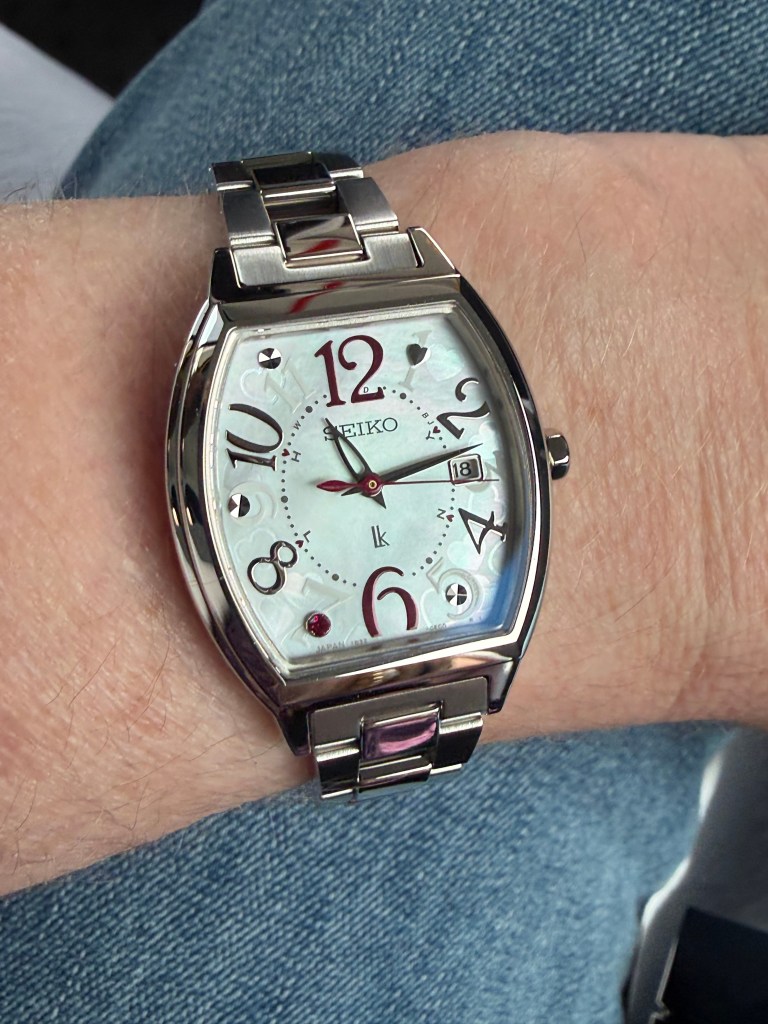
Ken is a horophile, which is a fancy way of saying he’s really into watches. He’s gotten me into horology, as well, which was an unfortunate development for our bank account. We wanted to visit Seiko House, the headquarters for Seiko, Grand Seiko, and Credor watches in Japan. Seven floors of watches. Forget spending a whole day in Ginza, we could have spent a whole day at Seiko House.
Ken’s more of a thoughtful, do-your-research watch purchase kind of guy. Meanwhile, I’m more like a raccoon who found a shiny object: see it, love it, buy it. Within rea$on, of course.
I asked the saleswoman if there were any watches you could only buy in Japan. She showed me what’s called a JDM watch – Japanese Domestic Market only. Seiko only made 600 of them. It’s solar powered – there’s literally a little solar panel in this watch. So cool. Bonus: Proceeds from the sale of this watch support the international humanitarian organization, Save the Children.
Of course I bought it.

Tsukiji Fish Market
Next stop: the historic Tsukiji Fish Market, which is a really great place to visit – even if you don’t like fish. And another place you could spend an entire day wandering around. Japan consumes more seafood per capita than almost any country on earth, which means the fish market is not a quaint cultural attraction – it is serious infrastructure. The famous pre-dawn tuna auctions, where a single bluefin tuna could sell for hundreds of thousands of dollars, became so popular with tourists that access eventually had to be restricted.
We looked at a lot of fish – was surprised how many vendors were super cranky about anyone taking pictures of their fish. I’m sure this is because once upon a time, some tourist backed into a $14,000 tuna while trying to get the perfect Instagram shot, and ruined it for the rest of us. Sigh. I get it, and I was respectful. But I did get a couple of stealth shots.
Izumi insisted we try some of his favorite snack – dried salty squid. Ohhhh I wish I hadn’t done that. Ditto, Ken. And now we have salty squid breath. 🤢


Knife Shopping in Asakusa
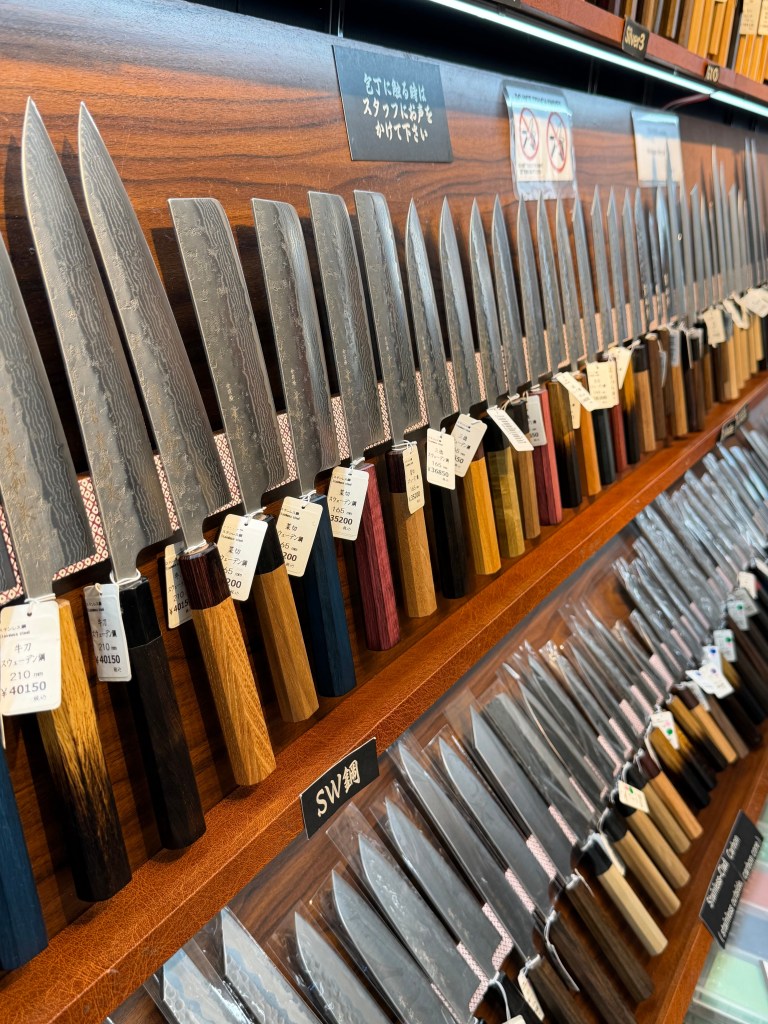
From there, Izumi took us to Asakusa, Tokyo’s old town, where we did not intend to buy a knife and then bought a knife. Japanese knife-making is a thousand-year-old tradition that traces directly back to samurai sword-making. The best Japanese knives are made by hand – by craftsmen who have spent years learning bladesmithing. A proper Japanese knife is not a kitchen tool. It’s a precision instrument.
I was somewhat surprised when Ken was so interested in the knives – considering all of the cooking Ken does not do. 😉 But he’s always been enamored with good craftsmanship. He picked out a stunning handmade walnut and Damascus steel knife. I now expect him to chop at least one vegetable annually.

Chado – The Way of Tea
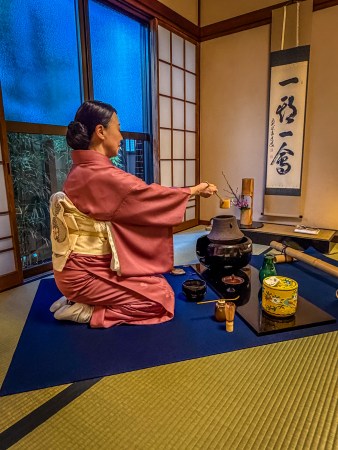
The highlight of the day for me was participating in a Japanese Chado, or matcha tea ceremony. Izumi took us to see his friend Miko, who has been practicing Chado for over 30 years. And bonus, she spent her teenage years in southern California, so she spoke perfect English.
Chado – the way of tea – is a Zen Buddhist practice that has been around for over five hundred years. The philosophy of chado is ichi-go ichi-e, which translates to, one time, one meeting. This exact combination of people, this exact room, this exact day and light, will never happen again. Chado asks you to sit with that, rather than thinking about whatever comes next. I thought the whole thing was genuinely moving. Ken, not so much.

The ceremony itself is very slow and precise (Ken never wanted a fast-forward button more in his life). Miko heated the water in a cast iron kettle to a very specific temperature – described by Miko as, “when it sounds like wind in the trees.” So now you know – wind is a temperature.

Chado Sweets
Before Miko prepared the matcha, she served us wagashi – sweets made from sweet bean paste and rice flour. They are supposed to prepare your palate for the bitterness of the tea. For all you Georgia O’Keefe fans, here’s some dessert inspiration for you. I loved it. Ken: this is heinous.

Ken would argue that nothing can prepare you for the bitterness of matcha in its raw form. He’s not wrong. Matcha is extremely bitter. People in the US who say they love matcha mean they love iced matcha lattes, which are basically desserts. And while people in Japan do drink matcha in various drinks and desserts (lattes, ice cream, and Kit-Kats), the tea ceremony is raw matcha. And raw matcha tastes (and looks) like someone liquified a fern.
You make matcha in a special bowl using a bamboo whisk called a chasen – a delicate whisk with dozens of fine tines that requires a specific wrist motion to produce the proper froth. Miko has been practicing her whisking technique for thirty years, which (foreshadowing) is apparently the amount of practice you need in order to get your tea to froth. Miko’s tea bowls are all handmade, all deliberately irregular, because wabi-sabi – the Japanese appreciation for imperfection – runs through the entire ceremony at every level. Nobody makes matching sets. Imperfection is the point.
I really like that idea.


Miko invited me to try whisking matcha myself.
This went about as well as the time my mother tried to teach me how to iron dress shirts. Technically I understood the concept of how to whisk matcha tea, but I produced something that could only charitably be described as a bowl of hot green juice. Miko watched me struggle for a moment, said nothing, and gently removed the bowl from my hands. She whisked it in about eight seconds. The froth was perfect. And I tried to look like I hadn’t just failed a five hundred year old test.
Chado Posture
The traditional posture for a tea ceremony is seiza – kneeling with your legs folded underneath you, sitting on your own heels, back straight, hands folded. Japanese people learn this position in childhood and they seem to be able to sit like this all day – and they look completely comfortable. Western people are not floor-kneelers. I may have been able to focus more on the zen of the chado and profound spiritual enlightenment had I not lost all sensation in my legs by the 4th minute of the ceremony.

Ken was a very good sport indulging me in this activity, which was absolutely not his cup of tea. 😉 Ken: one tea ceremony, lifetime. I’m never doing this again. Also, matcha is horrific.
Izakaya: Sake & Shōchū
As a finale to our day, we stopped at an Izakaya (a Japanese pub), which has been a fixture of Japanese social life since the Edo period (1603 to 1868), when sake shops figured out that customers stayed longer if you fed them. The word izakaya itself combines i (to stay) and sakaya (sake shop) – it’s literally a place to stay and drink.
We tasted sake from Izumi’s hometown , which was delicious, and shōchū, which, as far as I understood it, is basically sweet potato vodka. Not my thing, but I loved the sake.
More on sake and shōchū when I do my drinks post for Japan.


Also: tried this little bar snack, which I can only describe as soy sauce gummy bears. Didn’t mind the flavor, but the texture was weird. Weird textures in Asia take your mind to places it shouldn’t go.
And that’s a wrap on our very, very full day in Tokyo.
Kanpai! 🍶


Leave a Reply