
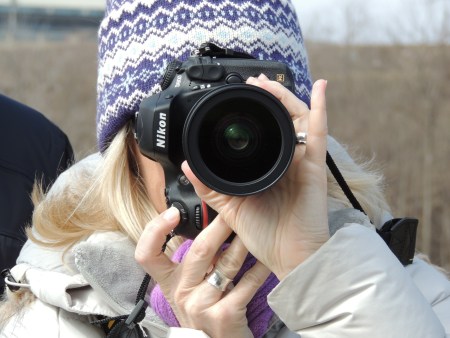
Here is the situation I find myself in every single time we travel: I own a Nikon D800, a Leica Q3, a Sony RX-10, and an iPhone 17 Pro Max. That is, objectively, too many cameras. And yet somehow, packing for a trip always involves the same impossible calculus: which one(s) comes with me, and which ones are sidelined at home.
Let me break down the contenders.

The DSLR (My Nikon D800): The One That Usually Stays Home
Let me be honest about something: my Nikon D800 is a magnificent camera that I almost never travel with anymore. It is heavy, bulky, and by the time I’ve stopped, unzipped the backpack, removed the camera, attached the lens, adjusted the settings, and raised it to my eye, the moment I wanted to photograph is gone.
It also weighs approximately as much as a small child. We do an unreasonable amount of walking when we travel, and carrying that thing 10 hours a day is just not feasible for me. So the D800 usually stays home.
Sidebar: If I know we’re going to be somewhere where I will want to do dedicated photography (wildlife, especially), I will bring it along. Places like Alaska and Africa.
If you are a professional photographer, or you have the patience of a saint and a very strong core, a full-frame DSLR or mirrorless camera will give you the best image quality available. The sensor size, the interchangeable lenses, the natural bokeh, the manual controls – there is genuinely no smartphone on earth that fully replicates what a serious camera can do. That gap is closing fast, but it hasn’t closed yet.
For everyone else: leave it at home.
The Leica Q3 and Sony RX-10: The Compromise Cameras
These are my middle ground options, and I travel with one or the other depending on what I think the day will require. The Leica Q3 is a fixed-lens camera – gorgeous image quality, compact enough to carry, but with zero zoom flexibility. The Sony RX-10 gives me zoom but at the cost of bulk and weight.


Here is the problem: whichever one I bring, I inevitably need the other one. This is not a camera problem. This is a Murphy’s Law problem, and no amount of careful planning has ever solved it.
The case for a dedicated travel camera – a mirrorless, a compact, a fixed-lens – is real if photography is a genuine priority for you and you’re willing to carry it every day without complaining. The image quality is meaningfully better than a phone in most situations, particularly in low light and when you want real depth of field. If you’re the kind of person who plans to print photos or shoot seriously, bring a real camera.
If you are going to leave it in the hotel room by day three because it’s too much hassle to carry around, don’t bother.
The iPhone 17 Pro Max: The One That’s Always With Me
Here’s the truth that every photographer eventually arrives at: the best camera is the one you have with you. And the one I have with me 99% of the time is my iPhone.

I recently upgraded from an iPhone 13 Pro Max to the 17 Pro Max, and the difference – particularly for travel photography – is significant. The zoom situation alone changed my street photography in ways I didn’t expect. The 13 had a 3x optical zoom that was, in practice, nearly useless for photographing anything farther than 10 feet away. The 17 Pro Max goes to 5x optical and all the way to 8x with the telephoto. For someone who loves street photography and requires a certain amount of stealth, this is a significant upgrade.
The low-light performance is dramatically better. The sensor is significantly larger. There’s a dedicated Camera Control button that launches the camera instantly – which matters more than it sounds when something catches your eye on a busy street and you have approximately two seconds to get the shot.
Does it replace a professional camera? No. The bokeh isn’t the same. The lens flexibility isn’t there. If you’re standing 400 meters from a subject or shooting the moon at midnight, a real camera wins every time. But for everything else – street photography, architecture, restaurant meals, landscape, portraits, the spontaneous moments that make up most of travel – the iPhone 17 Pro Max is genuinely extraordinary.
So What’s the Answer?
After years of traveling with every camera configuration imaginable, here is where I’ve landed:
Bring your phone and one dedicated camera. Not two. Not a full camera bag. One. If you know you’ll have time and subject matter (aka wildlife), bring the DSLR. For zoom and versatility, bring a compact mirrorless or a superzoom like the Sony RX-10. And if you love the look of prime lenses and don’t mind the constraint, something like the Leica Q3. And if you’re not a serious photographer and you have a current iPhone in your pocket, honestly – you might not need anything else at all.
What camera(s) do you bring with you when you travel?
Cheers! 📸


Leave a Reply