
Before we take a trip, I always try to do some reading that connects with our upcoming destination(s). I gravitate toward my favorite genre – historical fiction. For me, historical fiction helps make history more accessible and relatable. Ken is more of a non-fiction guy, but I don’t have the patience to get through A Concise History of Asia, so historical fiction it is.
We recently went on a Regent Seven Seas cruise out of Tokyo: southern Japan, a couple of days in Seoul, and a couple of days in Shanghai. This was my first time in Asia. Ken was stationed in Japan when he was on active duty with the Marine Corps, but he wasn’t exactly there in a sightseeing capacity.
You know I can’t think without a map, so here’s our route:

And here’s what I read before our trip:
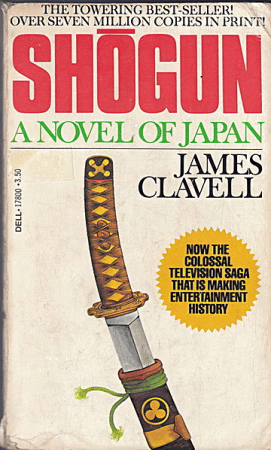
Shōgun by James Clavell (Japan)

An absolute doorstopper at just over 1,000 pages. Reading this book is basically a second job. I’m about to date myself, but I remember watching the original Shōgun miniseries with Richard Chamberlain in the 80s.
In a nutshell: An English sailor shipwrecks on the coast of feudal Japan in the 1600s – a deeply unfortunate time and place to wash ashore. He lands in a world he doesn’t understand – different language, customs, and power structures – and spends the entire book trying to navigate it. Sometimes brilliantly. Sometimes disastrously.
Also: there’s a lot of sword fighting.
What I took from it: the more Blackthorne learns about Japan, the more he realizes how much he doesn’t know. Got it, Japan is an onion. That’s useful preparation.
Fair warning: this is very much told from the “European guy discovers Japan” perspective, which is dated. But it’s also a good reminder that patience and strategy beat brute force every* single time – a lesson Blackthorne keeps learning the hard way.
*Ken: almost every time.
Pachinko by Min Jin Lee (Korea and Japan)

In a nutshell: A Korean family emigrates to Japan in the early 1900s, which was a terrible time to be Korean in Japan (Japan annexed Korea in 1910 and ruled it as a colony until 1945). The Japanese government forced Koreans to change their names, banned them from speaking their own language, conscripted them into labor camps, and forced women and girls into sexual slavery at Japanese military comfort stations. The racism in this novel is pervasive.
The relationship between Japan and South Korea remains – let’s go with complicated – today, even though the two countries are technically allies. Pachinko goes a long way toward explaining this. The wounds Lee writes about aren’t ancient history. They’re living memory, still raw in ways that don’t show up in diplomatic communiqués but absolutely show up in everything else.
As far as the characters go, Lee shows how displacement moves through a family like a current, shaping people who weren’t even alive when the original wound happened. Each generation inherits something they didn’t ask for, and has to figure out what to do with it. Some assimilate. Some fight back. The rest just try to get through the day. None of it is easy.
The title of the book refers to a pachinko machine, which is a game of chance, somewhere between a slot machine and pinball. It’s designed so that most people lose, but everyone keeps playing anyway. OK, I see you, Min Jin Lee. Ken told me he had one in his basement as a kid, so we visited a pachinko parlor while we were in Japan. For nostalgia.
Memoirs of a Geisha by Arthur Golden (Japan)

In a nutshell: A fisherman sells his own daughter to a geisha house in Kyoto (Father of the Year, right there), where she spends years discovering that beauty is only one small part of a world driven by ambition, power, rivalry, and survival. Geisha weren’t simply entertainers. They were strategists, operating inside an incredibly narrow set of options with discipline and intelligence that the word “entertainer” doesn’t come close to capturing.
This book is a really fascinating look at what it is – and what it isn’t – to be a geisha. Geisha are trained traditional and cultural entertainers – skilled in music, dance, conversation, and the tea ceremony. They are explicitly not prostitutes, and the distinction matters enormously to them. The confusion in the West largely comes from WWII-era “geisha girls” – a term used for a completely different category of women.
The best place to see geisha is in Kyoto, which was one of our stops. I would love to photograph a geisha, but you aren’t supposed to photograph them without permission. And I didn’t want to upset that apple cart.
Worth noting: Arthur Golden, an American, chose to tell the story through the eyes of a Japanese woman. The geisha community, however, was not exactly thrilled with his interpretation. Mineko Iwasaki – one of the most celebrated geisha of the 20th century – later sued him (the geisha community took offense to Golden blurring the line between Geisha and prostitutes) and wrote her own memoir in response. Fascinating.
The Valley of Amazement by Amy Tan (Shanghai, China)

I struggled with this one. I loved Amy Tan’s Joy Luck Club, so I had reasonably high hopes for this one. At almost 600 pages, it’s probably 200 pages longer than it needs to be. There’s a lot of overwrought trauma that just didn’t need to be so relentless.
In a nutshell: Set between late 19th and early 20th century Shanghai and America, the story follows Violet Minturn, a young woman who grows up in a high-end courtesan house owned by her American mother. So right away, we know poor Violet is going to have some issues.
Through a spectacularly long series of unfortunate events, Violet becomes separated from her mother and is forced into life as a courtesan. She spends the rest of the novel trying to survive while wrestling with her identity as someone caught between Chinese and American cultures.
Reading this back-to-back with Memoirs of a Geisha clarified one important distinction: geisha and courtesans are not the same thing – not even close. Geisha are cultural entertainers, highly trained in music, dance, and the art of conversation. Sex is not part of the arrangement. Courtesans are also entertainers – but sex is very much part of the deal.
White Chrysanthemum by Mary Lynn Bracht (Korea & Japan)

I’m glad I read Pachinko before White Chrysanthemum. I had the scaffolding of Japanese colonialism fresh in my mind going in.
Historians estimate that the Japanese military forced or coerced between 50,000 and 200,000 women across Asia—most of them Korean—into sexual slavery as so-called “comfort women” during World War II. In many cases, their families never learned what happened to them.
The novel tells the story of two Korean sisters whose lives unravel after the Japanese military kidnaps one of them during its occupation of Korea and forces her into sexual slavery at a military comfort station. The novel shifts between her fight for survival in the past and her sister’s life decades later, still shaped by a loss she has never properly grieved.
Serious political tensions between Japan and Korea over how to tell the history of the comfort women persist today. There has been no reparation, no formal apology, and no substantial governmental acknowledgment of what these women endured. What there has been is a systematic silencing of their voices.
There’s a note from the author that has stayed with me:
“Of those tens of thousands of women and girls enslaved by the Japanese military, only forty-four South Korean survivors are still alive (at the writing of this book in 2018) to tell the world what happened during their captivity, how they survived, and how they returned home. We will never know what happened to the other women and girls who perished before getting the chance to let the world know what they suffered .”
The number of registered South Korean comfort women survivors today is four.
Orphan Master’s Son by Adam Johnson (North Korea)

North Korea is never going to be on our travel itinerary, but after spending weeks reading about Korea’s complicated history – colonialism, war, division – I couldn’t stop at the 38th parallel. And once I started this one, I couldn’t put it down. The Orphan Master’s Son won the Pulitzer Prize in 2013. It earned it.
In a nutshell: Pak Jun Do is a young North Korean man who moves through a series of identities assigned to him by the North Korean state – tunnel fighter, kidnapper of Japanese citizens from their own beaches, ship radio operator, and eventually body double for a hero of the state. He doesn’t choose any of these identities. They’re issued to him, like a uniform.
What Johnson does that’s so unsettling is show how a totalitarian state doesn’t just control what people do – it controls what they’re allowed to want, remember, and feel. Citizens don’t have inner lives so much as approved narratives.
And yet, the book is often darkly funny and satirical – which turn out to be the sharpest tools in Johnson’s kit. There are 24-hour state loudspeakers, interrogators confused by the truth, and bureaucratic rituals for confessing to crimes you didn’t commit. The humor and satire land like a punch because it’s not really humor and satire. It’s just the system, described accurately.
A caveat: Johnson is an American writing about a society almost entirely closed to outsiders, which raises the same authorial questions as Shōgun and Memoirs of a Geisha: what does he get right, what does he get wrong, and how would we even know? What I can tell you is that the absurdities feel documented rather than invented, which is somehow the most frightening thing about it.
Concluding Thoughts
I finished reading and realized that all of these books are basically about the same thing: people surviving systems that were designed to destroy them. Feudal Japan, colonial Korea, imperial Shanghai, and the closed society of North Korea. Different eras, different circumstances, same basic human stubbornness. Nobody likes being told who to be.
I went to Japan, South Korea, and China with a lot more context than I had six months ago. I also went with a lot more questions.
Cheers!


Leave a Reply