
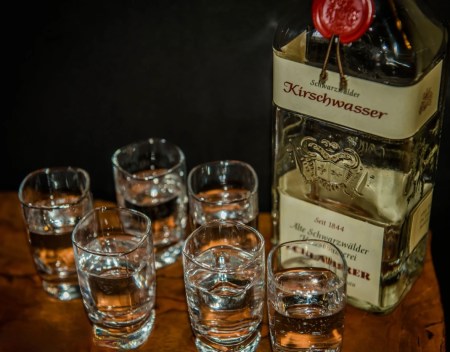
When Americans think about schnapps, we think peach and peppermint. And poor life choices. For Germans, schnaps is more than just a drink – it’s a cultural tradition. Distilled primarily from locally grown fruits like pears, cherries, apples, and plums, German schnaps is known for its purity, craftsmanship, and regional character. Ok, and probably a couple of poor life choices.

German vs. American Schnaps
Right off the bat, we need to get something straight. German schnaps and American schnapps are wildly different beasts. German schnaps is delicious. American schnapps (think: peach) is disgusting.
First: German Schnaps is spelled with one “p”. American Schnapps is spelled with two “p’s”, the second of which, is silent. The Germans don’t often include the word schnaps on a bottle of schnaps, favoring instead to label it with the type of schnaps (wildkirsch, or wild cherry, for example).


But the biggest difference between the two schnap(p)s is this: German schnaps is DRY, whereas American Schnapps is very sweet. Some other differences:
| German Schnaps | American Schnapps | |
|---|---|---|
| Alcohol Content | 38–40% ABV | 15–20% ABV |
| Sweetness | Dry | Very sweet |
| Made From | Fermented fruit or grain | Neutral spirit with added flavor/sugar |
| How to Drink | Sipped straight | Used in cocktails or shots |
| Flavor(s) | Apple, cherry, pear, apricot, plum | Peach, peppermint, butterscotch |
Peach schnapps and I are not currently on speaking terms. Back in my college days, we made a drink we called Purplesaurus Rex (I can’t remember how we came up with that name, but I’m sure there was alcohol involved). We were very proud of our recipe — it was peach schnapps mixed with grape Kool-aid. Horrifying, right? I have not had peach schnapps since 1991.

One exception: Butterscotch schnapps is outstanding in hot chocolate.
The Origin Story
The word Schnaps comes from the German word “snappen,” meaning “to snap” or “swallow quickly,” which (back when schnaps was probably some pretty rough stuff) was the traditional manner of drinking it. Today, though, high quality schnaps is enjoyed as a sipping drink.
Note: if you buy yourself a cheap, bottom-shelf bottle of schnaps, go ahead and snap that shit.
Germans have been making schnaps for over 800 years. During the 13th century, monks were among the few literate groups in society, and monasteries had access to ancient how-to manuals describing distillation methods. German monks spent a lot of time distilling herbs for medicinal purposes – wormwood for digestion and parasites, valerian for sleep, and sage for anxiety.
I’ve been burning a lot of sage for my anxiety lately.

By the 15th and 16th centuries, farmers had figured out basic distillation techniques, and began using their excess or overripe fruit to produce their own schnaps. Call it early craft distilling. Each German-speaking region developed its own unique schnaps, based on what grew there locally:
- Northern Germany: apples and pears
- The Black Forest Region: cherries
- Southern Germany / Bavaria: plums and apricots
- Alpine Germany: rowanberries (fruit from the mountain ash tree) and raspberries
The Rules
It’s Germany. Of course there are rules. The Germans have been regulating beer (Reinheitsgebot) since 1516. Spirits weren’t going to get a pass. Under German law, true schnaps must be made through fermentation and distillation—not by mixing alcohol with flavorings, as is common in many cheaper products. Sorry, peach schnapps.
Social and Cultural Role
Schnaps has always been more than just a drink. It’s a cultural tradition. Rare is the German dinner with friends that doesn’t end with schnaps. On our last trip to Munich, we finished dinner with an old family friend, and he says to us (we all knew it was coming): “We should have a schnaps. We won’t be able to sleep without one.”
Sidebar: Never try to out-drink a German. You will lose.
Ken’s Oma swore schnaps was “good for digestion”. And honestly, I think there is something to that. But she also believed it could cure everything from toothache to tuberculosis. The first time Ken and I ever had German schnaps, it was served to us by an 70 year old woman (Opa’s neighbor), who arrived carrying a tray with tiny glasses on it – that were filled with clear liquid – that was on fire. 🔥 The Germans do not mess around. But that’s a story for another day.
Schnaps Shopping in Munich
There are quite a few specialty liquor stores in Munich, but for selection and convenience, I go to Dallmyer or Galeria Kaufhof. Also: The Duty Free in the Munich Airport has a surprisingly good selection of schnaps.
Flavors of German Schnaps
Remember, with few exceptions, German schnaps will be dry. And, as is the case with any liquor, you can spend $5 or $50. Hell, you can spend $500 if you want to. But generally, you get what you pay for.
🍎🍐 1. Obstler (Fruit Brandy)
- A blend of apples and pears, this is the most common type of German schnaps.
🍒 2. Kirschwasser (Cherry Brandy)
- Distilled from fermented Morello cherries; a specialty of the Black Forest (Schwarzwald) region.
🌸 3. Zwetschgenwasser (Plum Brandy)
- Distilled from Damson plums. A close cousin to Slivovitz, from Eastern Europe.
- You may also see Mirabelle, which is made from yellow plums.
- There is no plum emoji (not a surprise), so enjoy this cherry blossom emoji instead.
🍐 4. Williamsbirne (Pear Brandy)
- Distilled from Williams (Bartlett) pears. A specialty of southern Germany, and my personal favorite.
🍑 5. Marille (Apricot Brandy)
- Distilled from apricots. Very popular in Bavaria and Austria.
🫐 6. Geist (made from non-fermentable ingredients)
- Distilled by soaking delicate fruits that do not ferment easily (like raspberries or blackberries) in neutral alcohol before distillation. The most common and popular is himbeergeist – raspberry.
- There is also no raspberry emoji, which seems like a glaring oversight.
Some High-Quality Schnaps Brands to Look For
It always helps me to have a picture of something if I’ve never bought it before, so here are four high-quality German schnaps brands to look for the next time you’re in Germany. Because you won’t find them here in the US. From left to right: Ziegler, Scheibel, Lantenhammer, and Marder.


Here’s to Tradition
The cultural (and family) tradition of German schnaps something I look forward to whenever we visit Germany, and one I bring home with me in my suitcase when we return.
Prost to schnaps!


Leave a Reply